Disclaimer: The information in this article is for general informational purposes only and does not constitute legal advice.
The hidden pattern behind accessibility claims, and how strategic response can change everything
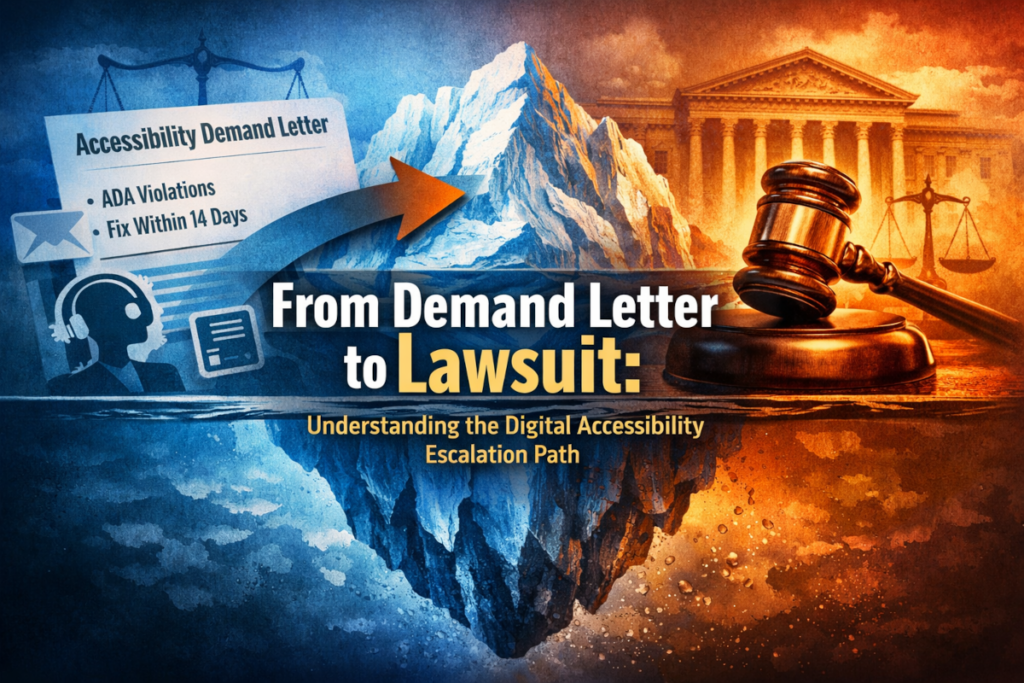
When we talk about digital accessibility enforcement, lawsuits grab the headlines. But here’s what most organizations miss: lawsuits are just the visible tip of a much larger iceberg. For every accessibility case that lands in court, dozens more begin quietly with a single letter, a demand alleging ADA violations and requesting action.
The real story isn’t in the courtroom. It’s in those critical first days after a demand letter arrives, when organizations make choices that either de-escalate risk or inadvertently accelerate toward litigation.
The Anatomy of an Accessibility Demand Letter
These letters follow a remarkably consistent playbook. They identify the sender as someone with a disability protected under the ADA. They assert that your website or mobile app presents barriers to users relying on assistive technology, typically screen readers or keyboard-only navigation. They reference WCAG 2.1 AA as the governing standard, despite it not being explicitly codified in the ADA itself.
Then comes the ask: fix the barriers within 14 to 30 days, and let’s discuss settlement.
The framing is deliberate. It positions the letter as an opportunity for quiet resolution while making litigation the implicit alternative. It’s a pressure mechanism, and it works because the underlying mechanics favor the plaintiff at nearly every stage.
Where Organizations Go Wrong
Most lawsuits don’t happen because plaintiffs are aggressive. They happen because organizations respond poorly, or don’t respond at all.
- Silence is the fastest accelerant. Ignoring a demand letter signals disengagement, not innocence. Plaintiffs interpret it as confirmation that litigation is their only path forward.
- Defensive posturing backfires. Organizations sometimes respond by insisting their sites are accessible, citing automated scans or accessibility widgets as evidence. When those claims contradict the lived experience of someone using a screen reader, trust evaporates and escalation follows.
- Overlays aren’t solutions. Many demand letters specifically call out barriers that widgets and overlays cannot address. Pointing to these tools as proof of compliance often triggers immediate filing.
- Vague promises don’t buy time. Responses that offer aspirational commitments without timelines, accountability, or specificity provide no reason for a plaintiff to pause. They suggest the organization isn’t taking the issue seriously.
These aren’t hostile acts. They’re structural missteps that make litigation look like the most efficient resolution mechanism available.
The Escalation Timeline: Predictable and Preventable
The progression from letter to lawsuit follows a pattern:
- A demand letter arrives. The organization has two to four weeks to respond. If the response is weak or absent, a second letter may follow, often with revised settlement terms. If engagement still doesn’t materialize, a complaint gets filed.
- Once litigation begins, defense costs climb rapidly. What might have been resolved for tens of thousands of dollars in early settlement now carries six-figure legal exposure, regardless of outcome.
- At each stage, the cost rises and control diminishes. The window for strategic response narrows quickly.
Why This Model Works
Accessibility demand letters succeed because they exploit an asymmetry:
- Accessibility defects are straightforward to document using widely available assistive technologies
- Remediation typically requires meaningful development work that can’t be completed in weeks
- Litigation costs frequently exceed early settlement amounts
- The legal standard is established, and plaintiffs have procedural advantages
This creates conditions where escalation becomes rational for plaintiffs when organizations appear unprepared or dismissive.
How to Interrupt the Pattern
Strategic response doesn’t require perfection. It requires credibility.
- Acknowledge immediately. Even if you can’t remediate within the deadline, a prompt acknowledgment demonstrates willingness to engage and respect for the process.
- Validate the claims independently. Commission a third-party accessibility audit. It provides factual grounding, signals good faith, and gives you a defensible basis for any response.
- Communicate a concrete plan. Effective responses include specifics: which digital properties are in scope, what the prioritized remediation roadmap looks like, who owns the work, and when milestones will be met. This demonstrates seriousness and competence.
- Don’t overclaim compliance. It’s far safer to acknowledge gaps and articulate how you’ll address them than to assert accessibility without evidence. The former invites collaboration; the latter invites litigation.
- Integrate legal and technical expertise. The strongest responses combine legal counsel who understands ADA risk with accessibility specialists who understand WCAG conformance and how assistive technologies actually behave. Neither discipline alone is sufficient.
When Lawsuits Become Inevitable
Certain conditions make escalation highly probable:
- No accessibility program exists
- No public accessibility statement or commitment is visible
- The organization has prior demand letters or lawsuits on record
- The digital experience is clearly transactional (e-commerce, services, registrations)
In these scenarios, plaintiffs often assume litigation is the only viable path and act accordingly.
Reframing the Risk
Demand letters aren’t random. They’re structured, repeatable mechanisms designed to surface accessibility failures and compel remediation. Organizations that understand this can respond strategically rather than reactively.
The difference between a demand letter and a lawsuit is rarely whether defects exist. It’s almost always about the quality, credibility, and speed of your response.
Treat these letters as early warning systems, not attacks. They’re inflection points, moments when you can choose de-escalation over default litigation. The organizations that recognize this tend to resolve issues quietly, strengthen their accessibility programs, and reduce their overall risk profile.
The ones that don’t end up in court, where the only certainty is that resolution will be slower, more expensive, and more public than it needed to be.