Disclaimer: The information in this article is for general informational purposes only and does not constitute legal advice.
The accessibility demand letter represents a inflection point, not merely a legal threat, but a diagnostic moment that reveals how an organization handles risk, operational readiness, and stakeholder accountability.
For business owners navigating market competitiveness, product managers balancing feature roadmaps against foundational requirements, and legal and compliance teams managing enterprise exposure, these letters surface a critical question: Does your organization’s response architecture match the sophistication of the risks you face?
The Response-Outcome Correlation
Our analysis of demand letter outcomes reveals a pattern that should concern any risk-conscious leadership team: the presence of accessibility gaps is rarely the determining factor in litigation escalation. Your response strategy is.
Organizations demonstrating structural preparedness and evidence-based engagement consistently achieve better outcomes across three dimensions: legal cost containment, settlement positioning, and long-term claim prevention. Conversely, organizations defaulting to delay, denial, or procedural deflection reliably amplify both immediate and downstream risk.
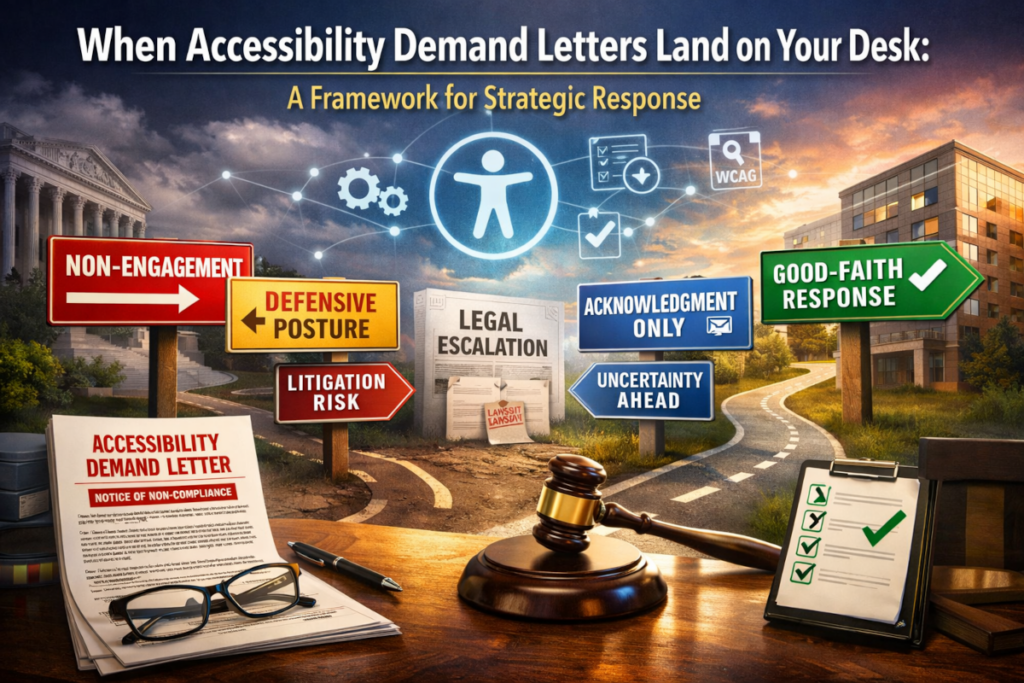
Four Response Pathways: A Strategic Analysis
Pathway 1: Non-Engagement
Decision posture: Silence or delayed acknowledgment beyond stated deadlines.
Organizational signal sent: Lack of governance maturity; absence of cross-functional risk protocols.
Outcome trajectory:
- Immediate loss of narrative control
- Plaintiff proceeds with standardized litigation playbook
- Defense costs escalate; settlement leverage erodes
- Pattern establishment increases probability of serial claims
Risk classification: Severe
Pathway 2: Defensive Posturing
Decision posture: Categorical denial, reliance on unvalidated compliance assertions, or citation of automated overlay solutions.
Organizational signal sent: Disconnect between legal response and technical reality; potential misunderstanding of accessibility verification standards.
Outcome trajectory:
- Adversarial testing intensifies
- Documentation of discrepancies strengthens plaintiff position
- Accelerated litigation filing with enhanced allegations
- Erosion of settlement credibility
Risk classification: Elevated
Pathway 3: Acknowledgment Without Architecture
Decision posture: Generic commitment to future improvement lacking specificity, ownership, or technical substance.
Organizational signal sent: Recognition without remediation capacity; absence of operationalized compliance framework.
Outcome trajectory:
- Temporary de-escalation window
- Follow-up demands with increased financial expectations
- Ultimate escalation upon failure to demonstrate measurable progress
- Opportunity cost of early resolution
Risk classification: Moderate to Elevated
Pathway 4: Structured Good-Faith Engagement
Decision posture: Prompt response demonstrating independent verification, remediation planning, and WCAG 2.1/2.2 Level AA alignment.
Organizational signal sent: Operational maturity; cross-functional coordination; evidence-based risk management.
Outcome trajectory:
- Credible negotiation foundation established
- Settlement frameworks emphasize remediation over punitive damages
- Sustainable cost containment
- Institutional learning reduces recurrence probability
Risk classification: Managed
Strategic Implications for Leadership
For Business Owners: Accessibility demand letters function as early-warning indicators of operational debt. The financial differential between structured response and reactive litigation can represent 3-5x cost variation, capital better allocated to competitive differentiation than legal defense.
For Product Managers: These letters expose the technical debt embedded in feature-first development cultures. Response quality correlates directly with whether accessibility requirements are treated as post-launch remediation tasks or integrated acceptance criteria from design inception.
For Legal and Compliance Teams: Demand letter response is fundamentally a cross-functional exercise. Legal positioning cannot compensate for absent technical remediation architecture. The organizations achieving optimal outcomes demonstrate tight coordination between legal strategy, product engineering, and accessibility expertise.
The Decision Architecture Principle
Accessibility demand letters are not isolated legal events requiring compartmentalized legal response. They are organizational stress tests revealing whether compliance infrastructure, technical validation processes, and risk governance mechanisms function in coordination or operate in silos.
The framework is elegantly simple: Organizations that respond with verifiable capability and structured intent reduce escalation probability. Organizations that respond with delay, denial, or declarative assertions absent supporting evidence reliably amplify it.
The question for leadership is not whether accessibility gaps exist, virtually all digital properties contain remediable issues. The question is whether your organization’s response architecture demonstrates the maturity to manage them strategically.
In an environment where accessibility litigation has evolved from sporadic enforcement to systematic plaintiff strategy, response quality is not a legal nicety. It is a competitive differentiator, a cost-containment mechanism, and a proxy for organizational effectiveness.
The organizations that understand this distinction don’t just respond to demand letters more effectively. They build the foundational capabilities that reduce the probability of receiving them in the first place.