As a Solutions Engineer at a leading digital accessibility consulting firm, I work with organizations across industries navigating the accessibility audit process. I see four primary drivers that bring organizations to the table:
- A need for a VPAT
- A legal complaint or settlement
- Risk reduction
- A genuine commitment to doing the right thing
The most common of these, by far, is the need for a VPAT. And it’s where I see the most significant waste of investment.
What Is a VPAT, Really?
A Voluntary Product Accessibility Template (VPAT) is a standardized document vendors use to describe how their products or services conform to established accessibility standards. It covers digital products ranging from software and websites to mobile applications and electronic devices, evaluating conformance against frameworks like Section 508 of the Rehabilitation Act, the Web Content Accessibility Guidelines (WCAG), and the EU’s EN 301 549.
The VPAT functions as a structured checklist across key dimensions of accessibility: perceivability, operability, and compatibility with assistive technologies.
One important distinction worth clarifying: a VPAT is a template. Once completed, it becomes an Accessibility Conformance Report (ACR). The two terms are used interchangeably in practice, but technically a VPAT is the blank template and an ACR is the finished product. The ACR’s purpose is to give procurement decision-makers, particularly government agencies and large enterprises, a clear picture of whether a product meets their accessibility requirements.
A Pattern That Should Concern Every Product Leader
Here is what I see repeatedly: organizations treat the ACR as the finish line.
They invest anywhere from $15,000 to $50,000 or more in a comprehensive accessibility audit, then an additional $2,000 to $5,000 to produce the VPAT/ACR itself. Since a VPAT should be refreshed annually, this becomes a recurring cycle. Year after year, organizations spend this significant sum, file the report, and move on.
The accessibility of the product, meanwhile, stays flat or deteriorates.
For some organizations, that may be sufficient. If the receiving party simply files the ACR without scrutiny, the checkbox is checked. But procurement standards are evolving. A growing number of buyers actively evaluate the substance of an ACR, not just its existence. Organizations that pay for audits purely to generate a document, without acting on the findings, are increasingly losing the very deals that created the need for the VPAT in the first place.
The Real Cost of Inaction
Here is what most organizations overlook. A well-executed accessibility audit delivers two distinct categories of value:
- Identification and reporting of accessibility findings
- Documented, actionable guidance to remediate those findings
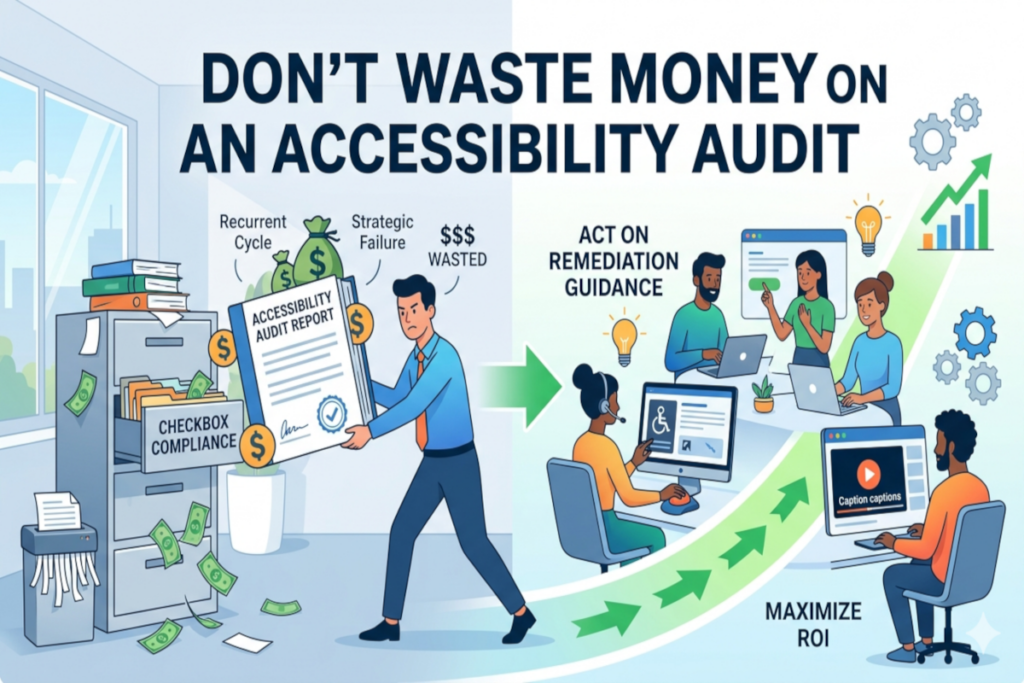
These two components are roughly equal in value. When an organization receives an audit, acts on the first deliverable to generate a VPAT, and ignores the second, they are discarding 50 to 60 percent of what they paid for.
That is not a rounding error. That is a strategic failure.
How to Get Full ROI from an Accessibility Audit
The path forward is straightforward, even if it requires intentional prioritization. When you commission an audit, build a remediation plan into the engagement from the start. You do not need to fix everything at once.
Prioritizing critical and high-severity findings alone typically resolves up to 60 percent of the barriers that meaningfully block users with disabilities. That level of improvement, achieved systematically, transforms an audit from a compliance document into a genuine product quality investment.
The VPAT matters. But the work behind it matters more.