We stand at an inflection point. The question is no longer whether digital accessibility matters, it’s whether your organization will lead or follow as this imperative reshapes competitive dynamics across every industry.
The Awakening: 2025’s Accessibility Reckoning
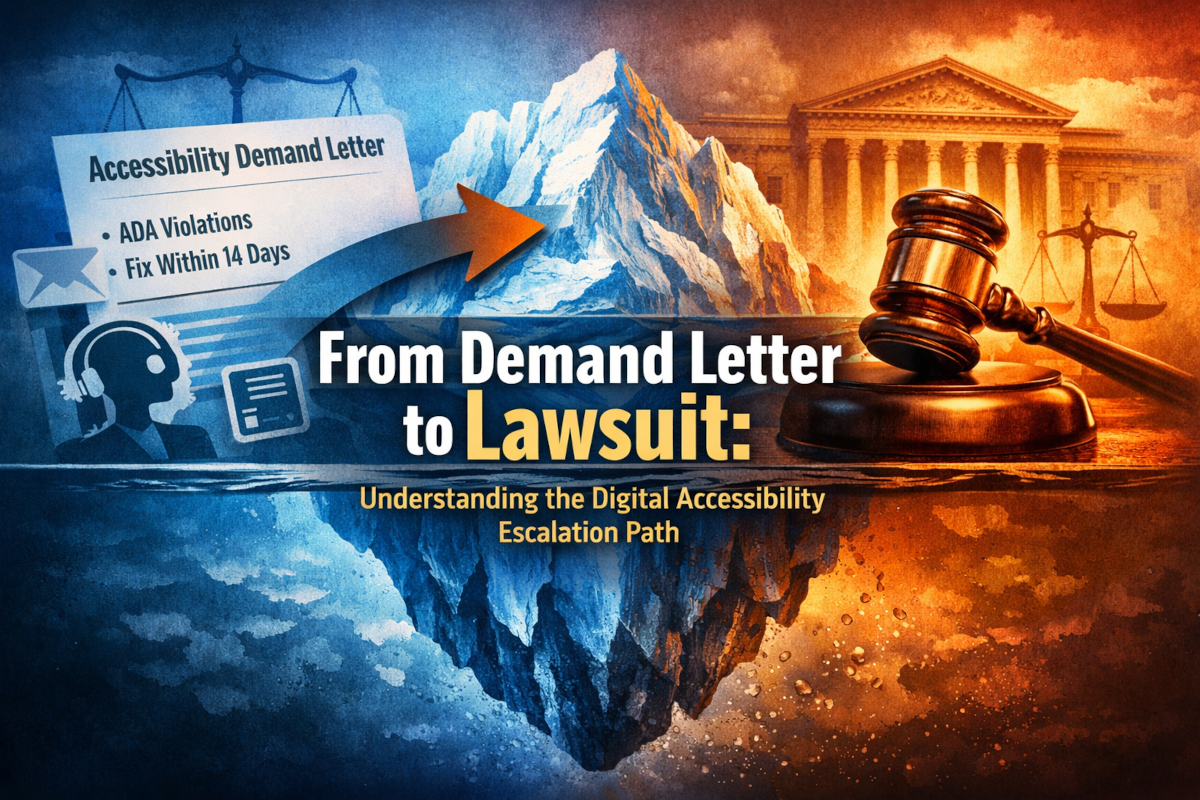
The numbers tell a story of transformation. With over 2,000 accessibility lawsuits filed in just the first half of 2025, a 37% surge from the previous year, we’re witnessing more than a litigation trend. We’re observing the market’s mechanism for enforcing inclusion at scale. Current trajectories suggest we’ll surpass 5,000 cases in 2025, but the visible litigation represents merely the tip of a much larger iceberg of demand letters, settlements, and quiet compliance adjustments happening beyond public view.
This isn’t statistical noise. It’s a fundamental realignment of how businesses must think about their digital presence.
Where Disruption Concentrates: The Industry Perspective
The pattern of enforcement reveals something profound about modern commerce, based on early 2025 lawsuits.
- Restaurants, Food & Beverage: approximately 30.5%.
- Lifestyle, Fashion & Apparel: approximately 28.8%.
- Beauty & Skin Care: approximately 8.9%.
- Medical & Health Services: approximately 7.1%.
- Other affected sectors include furniture and home décor, consumer services, and general retailing.
Together with beauty, healthcare, and retail, just ten sectors absorb over 90% of all accessibility litigation.
What connects them? High-frequency consumer touchpoints. Digital-first customer relationships. Brands built on experience, not just transactions.
The insight here transcends legal risk: the industries being targeted first are those where digital accessibility has the most immediate business value. This isn’t punitive enforcement, it’s the market correcting for a design debt that has real human costs.
Geography as Destiny: The Expanding Litigation Frontier
New York’s 637 cases in the first half of 2025 surprised no one. But Florida’s dramatic rise to 487 cases, nearly double its prior volume, signals something more interesting. Illinois’ 745% year-over-year increase, from 28 to 237 lawsuits, suggests we’re past the “coastal phenomenon” narrative.
Accessibility litigation is democratizing geographically because digital commerce itself has no borders. A Chicago-based plaintiff can encounter the same barriers as one in Manhattan. As awareness spreads and legal infrastructure matures in secondary markets, expect enforcement to become truly national.
The strategic question: Are you prepared for scrutiny in markets you hadn’t considered vulnerable?
The Anatomy of Failure: Why Good Intentions Aren’t Enough
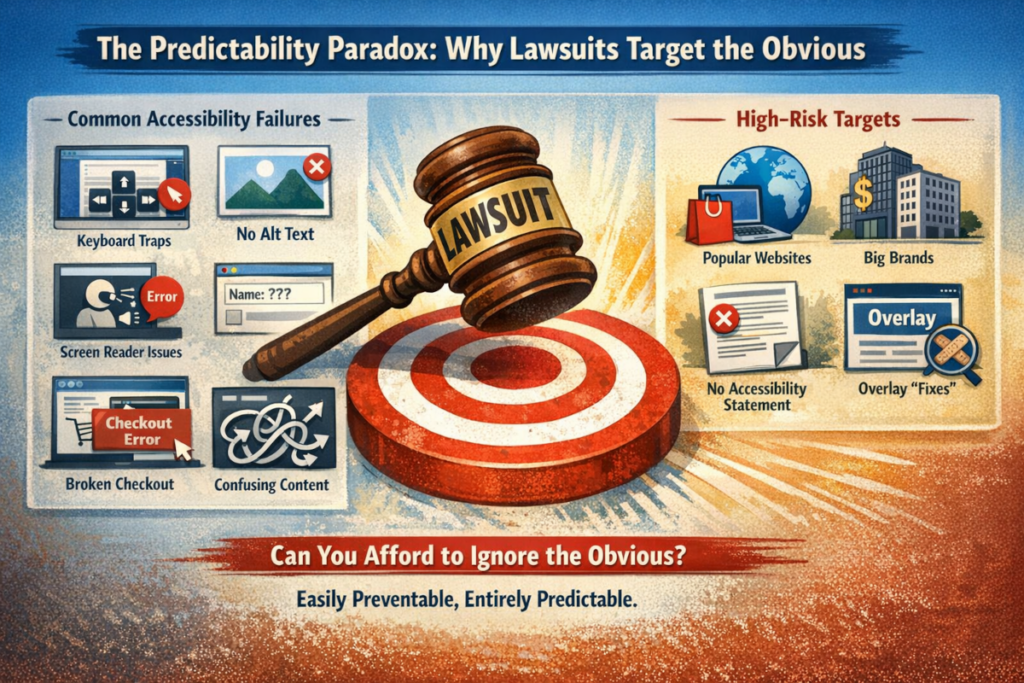
Serial plaintiffs and specialized law firms drive volume, yes. But they succeed because the underlying failures are endemic. Missing alt text. Keyboard navigation failures. Inaccessible forms and checkout flows. These aren’t edge cases, they’re fundamental design oversights that compound across millions of digital interactions.
Perhaps most revealing: a significant portion of sued organizations had deployed accessibility widgets or overlays, believing they’d addressed the problem. These cosmetic solutions became evidence of awareness without meaningful remediation. The lesson is unambiguous, superficial compliance is worse than no compliance because it demonstrates you knew there was a problem and chose not to solve it properly.
The Path Forward: Accessibility as Strategic Architecture
Leading organizations are already moving beyond compliance theater to embed accessibility into their strategic DNA. The framework is clear:
Standards as Foundation, Not Ceiling
WCAG 2.1 or 2.2 Level AA isn’t a regulatory checkbox, it’s the baseline for inclusive digital design. Organizations that treat it as the floor, not the ceiling, build experiences that serve broader audiences and adapt more readily to emerging assistive technologies.
Integration Over Remediation
Accessibility embedded in design systems, development workflows, and QA processes costs a fraction of retroactive fixes. More importantly, it produces superior products. When you design for the edges of human ability, you strengthen the center.
Evidence Through Diversity of Validation
Automated testing catches perhaps 30-40% of accessibility issues. Manual audits by specialists surface another layer. But testing with actual users who have disabilities, the people your products must serve, reveals the truth about usability. This isn’t charity work; it’s the only reliable form of quality assurance for accessibility.
Documentation as Strategic Asset
Accessibility audits, remediation roadmaps, and improvement timelines aren’t just defensive paperwork. They’re evidence of organizational seriousness, strategic planning, and commitment to continuous improvement. In an environment where good faith efforts influence outcomes, documentation becomes protective infrastructure.
The Overlay Illusion: Why Shortcuts Accelerate Failure
The fastest way to appear compliant is often the surest path to meaningful failure. Accessibility overlays and widgets promise instant remediation, a seductive proposition in boardrooms where speed and cost efficiency drive decision-making. But this is precisely where strategic thinking diverges from tactical expedience.
These tools don’t solve accessibility problems. They obscure them. Worse, they signal something damaging: that your organization knew barriers existed and chose cosmetic fixes over structural integrity. In litigation, this awareness without action becomes evidence of knowing neglect rather than innocent oversight.
The fundamental truth: Accessibility isn’t a layer you apply. It’s architecture you build.
Real accessibility lives in the foundational code, semantic HTML that communicates meaning, ARIA attributes that bridge gaps for assistive technologies, and design patterns that respect how humans actually interact with digital interfaces. These structural elements can’t be retrofitted through JavaScript injections any more than you can add earthquake resistance to a building by installing better door locks.
Organizations that invest in core accessibility infrastructure don’t just achieve stronger compliance. They build digital products that are faster, more maintainable, more SEO-friendly, and more adaptable to emerging technologies. They create experiences that work for the broadest spectrum of human ability, not because a widget intercepts and attempts to repair broken interactions, but because those interactions were designed correctly from inception.
The choice isn’t between overlay solutions and structural accessibility. It’s between appearing to care and actually solving the problem. Markets, courts, and users increasingly know the difference.
Organizational Literacy as Competitive Advantage
When product managers, designers, and engineers understand accessibility principles, they make better decisions at every fork in the road. Education transforms accessibility from a specialized concern into shared product DNA, reducing expensive late-stage corrections and accelerating innovation.
The Larger Context: From Risk Mitigation to Market Leadership
Here’s the reframe that separates leaders from followers: The same accessible design that reduces litigation risk also expands addressable markets, improves SEO performance, enhances mobile usability, and signals brand values that increasingly matter to consumers.
The one billion people globally with disabilities represent $13 trillion in disposable income. Aging populations in developed markets are rapidly expanding the pool of users who benefit from accessible design. And every user, at some point in their journey, encounters temporary or situational limitations that accessible design accommodates.
Organizations approaching accessibility purely through a risk lens are missing the strategic opportunity. Those building truly inclusive digital experiences aren’t just avoiding lawsuits, they’re accessing growth that their competitors literally cannot see.
The Choice Ahead
The 2025 litigation data isn’t a warning. It’s a mirror.
It reflects an industry-wide failure to prioritize inclusive design when the barrier to entry was low and the cost of correction was modest. Now, organizations face a choice: continue addressing accessibility reactively, through settlements and hasty remediation, or embrace it as a strategic discipline that makes their products better and their businesses more resilient.
The second path requires investment, yes. But it’s investment that compounds, in reduced legal exposure, expanded market access, improved user satisfaction, and the organizational capability to move faster as accessibility standards evolve.
The market is making its expectations clear. The only remaining question is whether your organization will treat this moment as a threat to be managed or an opportunity to be seized.
In an increasingly digital world, accessibility isn’t a feature. It’s the foundation of sustainable competitive advantage.