Note: The creation of this article on testing Consistent Help was human-based, with the assistance on artificial intelligence.
Explanation of the success criteria
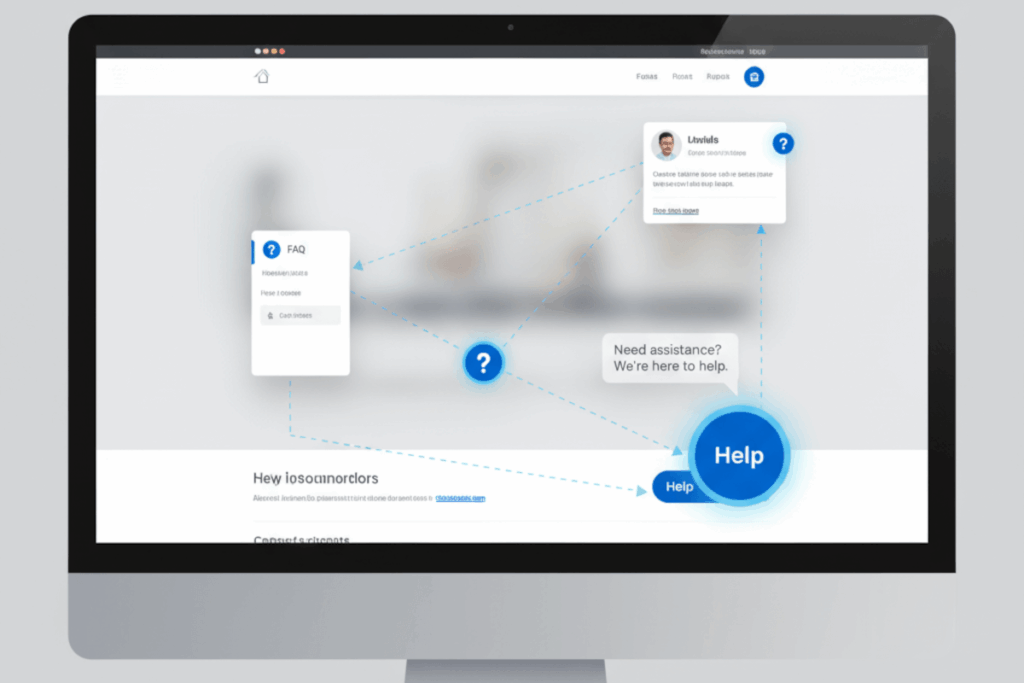
WCAG 3.2.6 Consistent Help is a Level A conformance level Success Criterion. It emphasizes the critical role of predictability and reliability in user support mechanisms across digital experiences. This Success Criterion requires that help features, guidance, and instructional content be presented in a consistent manner throughout a website or application. By maintaining uniform placement, design, labeling, and behavior for help resources, users can confidently locate assistance without confusion or cognitive overload.
Consistent Help is particularly vital for users with cognitive disabilities, new users, or those navigating complex interfaces, as it fosters trust and independence. Implementing this principle requires intentional design decisions, from standardizing help icons and tooltips to ensuring that instructional patterns remain uniform across pages and components. In practice, Consistent Help transforms digital experiences from fragmented and unpredictable to intuitive and empowering, ensuring that assistance is always accessible when and where it is needed.
Who does this benefit?
- Users with cognitive or learning disabilities: Gain predictable, clear guidance that reduces confusion and supports task completion.
- New or infrequent users: Benefit from familiar help patterns that minimize the learning curve.
- Users navigating complex systems: Receive consistent support across forms, tools, and interactive components, improving efficiency.
- Developers and designers: Gain insights into gaps or inconsistencies in help content, enabling stronger UX design.
- Organizations and businesses: Reduce support costs and enhance satisfaction by providing intuitive, accessible help.
- Accessibility testers and auditors: Obtain a clear framework to evaluate the uniformity and effectiveness of help resources.
Testing via Automated testing
Automated testing offers speed and breadth, quickly scanning large volumes of content to identify missing help elements, inconsistent labeling, or structural variations in tooltips, modals, and instructional text. Its primary advantage is efficiency, it can flag obvious gaps across entire sites or applications. However, automated tools struggle to assess contextual relevance, clarity, and user perception, which are central to evaluating true consistency in help.
Testing via Artificial Intelligence (AI)
AI-based testing brings nuance, leveraging machine learning to detect patterns, semantic similarities, and potential inconsistencies that automated tools miss. AI can simulate user journeys and highlight areas where help content might confuse or mislead, providing actionable insights for improvement. Yet, AI’s predictions are only as good as the models and training data it relies on; subtle design or language nuances may be misinterpreted.
Testing via Manual testing
Manual testing, while time-intensive, remains indispensable for a thorough evaluation. Human testers can assess the usability, readability, and practical consistency of help content across contexts, devices, and user scenarios, ensuring that guidance is genuinely coherent and supportive. The downside is cost and scalability, especially for large, dynamic websites.
Which approach is best?
A hybrid approach to testing WCAG 3.2.6 Consistent Help combines the efficiency of automated tools, the contextual intelligence of AI, and the discerning eye of manual evaluation to deliver a comprehensive and reliable assessment.
The process begins with automated testing, which rapidly scans an entire website or application to identify missing help features, inconsistent labeling, or structural discrepancies in instructional content, tooltips, and guidance elements.
These findings are then refined through AI-based testing, which evaluates patterns, semantic similarities, and the contextual placement of help content, predicting areas where users might experience confusion or inconsistency. AI can simulate user journeys and interactions, highlighting potential friction points and suggesting optimizations for clarity and coherence.
Finally, manual testing validates both automated and AI findings, allowing human testers to assess real-world usability, readability, and the practical effectiveness of help content across devices, contexts, and user scenarios. This step ensures that instructions are not only consistently presented but also genuinely intuitive and supportive.
By integrating these three methods, organizations can achieve a thorough, actionable understanding of their help resources, ensuring they meet accessibility standards while delivering a seamless, user-friendly experience that empowers all users.