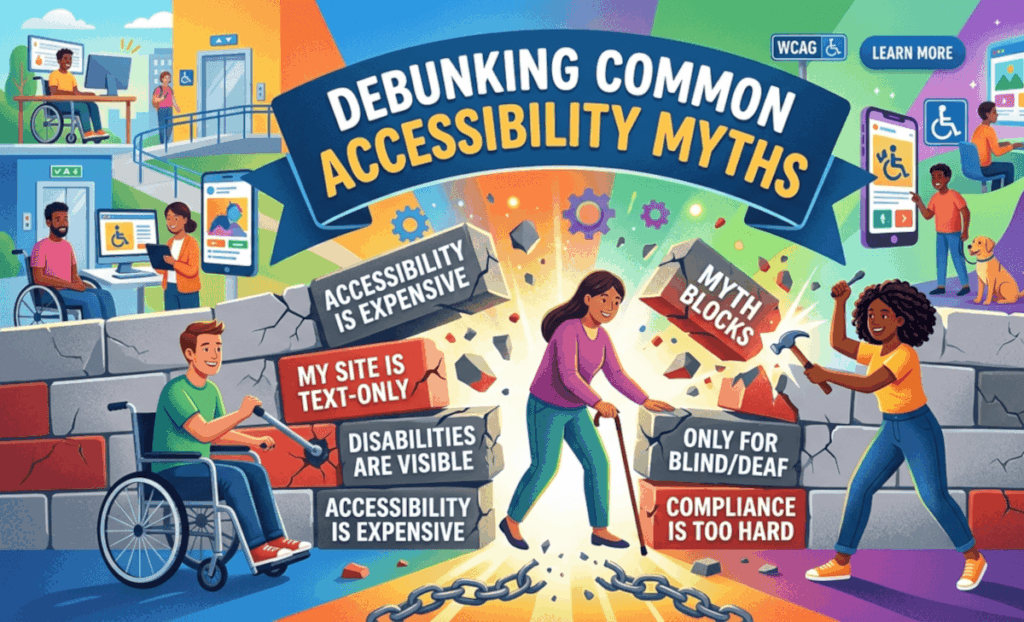
Accessibility is rarely held back by technical limitations. More often, it stalls because of outdated assumptions and persistent myths. If you want to accelerate progress, this is where to start, by challenging what people think they know.
Myth 1: Accessibility Is Expensive
This belief continues to derail initiatives before they even begin. The reality is more nuanced.
Accessibility becomes expensive when it is treated as an afterthought. Retrofitting a complex application to meet accessibility requirements often involves redesign, re-engineering, and re-testing. That is where costs escalate.
When accessibility is embedded early, during design, development, and content creation, the cost impact is minimal and often negligible.
Real-world example
A design team that chooses sufficient color contrast, clear typography, and accessible interaction patterns from the outset avoids costly rework later. Compare that to a product that launches and then must rebuild its UI components to meet contrast or keyboard accessibility requirements.
Strategic takeaway: Accessibility is not a cost center. It is a cost control mechanism.
Myth 2: Automated Tools Can Solve Everything
Automation plays an important role, but it is not a silver bullet.
Most automated testing tools identify only a subset of accessibility issues, often around 30 to 40 percent. They are excellent at catching detectable failures such as missing alternative text or improper ARIA usage. They cannot evaluate context, usability, or meaning.
Real-world example
An automated scan may confirm that all images have alternative text. It cannot tell you whether that text is meaningful, redundant, or completely unhelpful to a screen reader user.
Strategic takeaway: Automation scales efficiency. Human evaluation ensures quality.
Myth 3: Accessibility Only Benefits a Small Group
This is one of the most limiting misconceptions, and one of the easiest to disprove.
Disability is not a niche condition. It is a continuum that includes permanent, temporary, and situational limitations.
Real-world examples
- A user with a broken arm relying on keyboard navigation
- A commuter trying to watch a video without sound in a noisy environment
- An aging population experiencing gradual vision loss
Features like captions, larger touch targets, and clear navigation benefit all of these users, not just those with permanent disabilities.
Strategic takeaway: Accessibility is usability at scale.
Myth 4: Accessibility Stifles Creativity
There is a persistent fear that accessibility introduces constraints that limit design expression. In practice, the opposite happens.
Constraints force clarity. They challenge teams to simplify, prioritize, and communicate more effectively.
Real-world example
Design systems that enforce accessible color contrast and consistent interaction patterns often produce cleaner, more cohesive user experiences. Instead of limiting creativity, they remove ambiguity and friction.
Strategic takeaway: Accessibility is a catalyst for better design, not a barrier to it.
Myth 5: Accessibility Is a One-Time Effort
This mindset is particularly risky.
Digital products are not static. Content updates, new features are introduced, and standards evolve. Accessibility must keep pace with all of it.
Real-world example
A website that achieves compliance during a redesign can quickly regress if new content is published without accessibility considerations, or if new components are introduced without proper testing.
Strategic takeaway: Accessibility is an operational discipline, not a project milestone.
Reframing the Narrative
When these myths persist, accessibility is treated as a burden. When they are removed, it becomes what it actually is, a driver of quality, innovation, and reach.
Organizations that move fastest are not the ones with the most resources. They are the ones with the clearest understanding.
Call to Action
Start by shifting perception within your organization. Share these insights with your teams, challenge assumptions, and integrate accessibility into everyday decision-making.
Because meaningful progress does not begin with tools or standards. It begins with how people think.