Summary
This is a series of 24 articles on digital accessibility posted on Global Accessibility Awareness Day (GAAD) 2026. Want to participate? Share this article with others in your network.
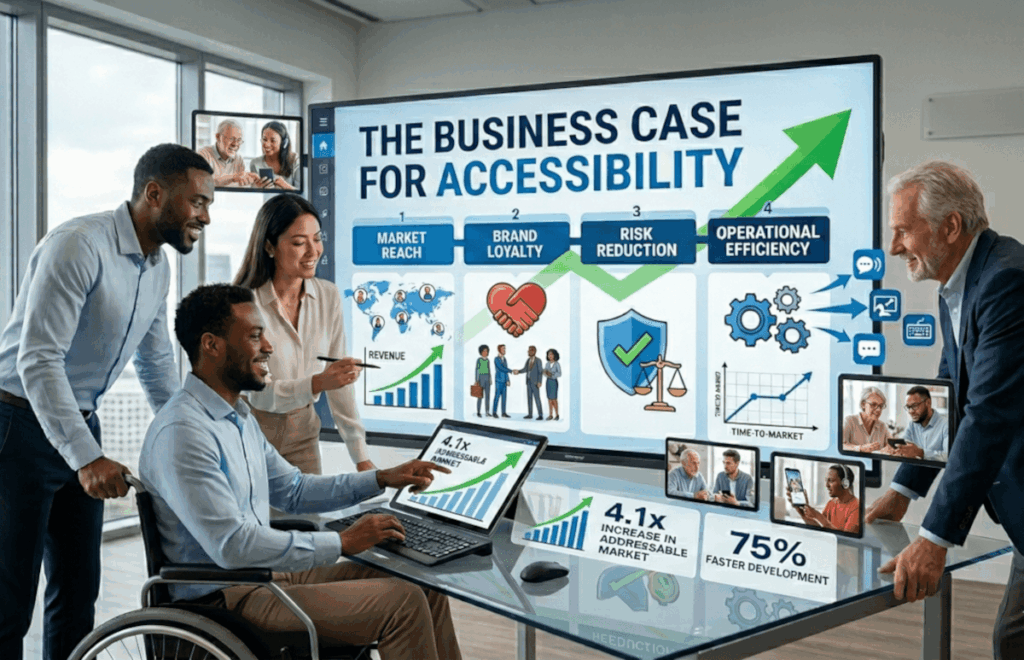
Accessibility is still too often treated as a regulatory hurdle, something to satisfy legal requirements and move on. That framing misses the bigger picture entirely. Accessibility is not a constraint on the business. It is a lever for growth, resilience, and innovation.
Organizations that understand this are not just more compliant. They are more competitive.
Expanding Market Reach
Accessibility directly impacts who can use your products and services. When digital experiences exclude people with disabilities, they also exclude revenue.
This is not a niche audience. It includes millions of individuals with permanent disabilities, along with people navigating temporary or situational limitations. Consider a parent holding a child while browsing on a phone, or a commuter trying to read content in bright sunlight. Accessibility improves usability in all of these contexts.
Real-world example
A retail company that improves color contrast, simplifies navigation, and ensures screen reader compatibility does not just support blind or low-vision users. It also reduces friction for aging customers and mobile users, increasing overall conversion rates.
Accessibility broadens your total addressable market. That is a growth strategy, not a compliance task.
Reducing Legal and Reputational Risk
Regulatory expectations around accessibility continue to evolve, and enforcement is becoming more consistent. Organizations that take a reactive approach often find themselves addressing issues under pressure, with higher costs and public scrutiny.
Proactive accessibility changes that dynamic.
Real-world example
Companies that embed accessibility into their development lifecycle are far less likely to face demand letters or lawsuits. When issues are identified early, remediation is faster, cheaper, and less disruptive.
Beyond legal exposure, there is reputational risk. Accessibility failures are increasingly visible and publicly discussed. A single inaccessible experience can quickly become a brand liability.
Risk management is not just about avoiding penalties. It is about maintaining trust.
Strengthening Brand Trust and Loyalty
Customers, employees, and partners are paying closer attention to how organizations show up in the world. Accessibility is a visible, measurable expression of inclusion.
When organizations invest in accessible experiences, they signal that they value all users, not just the majority.
Real-world example
Streaming platforms that provide high-quality captions and audio descriptions are not only meeting accessibility needs. They are creating better experiences for multilingual audiences, users in sound-sensitive environments, and anyone who prefers alternative ways to engage with content.
This kind of intentional design builds loyalty. People remember when a product works for them, especially when others do not.
Driving Operational Efficiency
Accessibility is often perceived as additional work. In reality, it reduces inefficiency when integrated early.
Clear semantic structure, reusable components, and consistent design patterns make systems easier to build, test, and maintain. Teams spend less time retrofitting solutions and more time delivering value.
Real-world example
Design systems that include accessible components, such as properly labeled form fields or keyboard-navigable menus, eliminate the need to solve the same problems repeatedly across teams. This reduces rework and accelerates development cycles.
Accessibility is not just about the end user. It improves how teams work together.
Fueling Innovation
Some of the most transformative features in modern technology began as accessibility solutions.
Voice interfaces, predictive text, captions, and flexible input methods all emerged from efforts to meet diverse user needs. Designing for edge cases often leads to breakthroughs that benefit everyone.
Real-world example
Speech-to-text technology, originally developed to support users with mobility impairments, is now foundational in mobile devices, virtual assistants, and productivity tools.
Constraints drive creativity. Accessibility expands the range of problems teams are solving, and that is where innovation happens.
A Strategic Advantage, Not a Checkbox
Organizations that treat accessibility as a late-stage requirement will always be catching up. Those that embed it into strategy, culture, and process move faster and deliver better outcomes.
Accessibility aligns naturally with core business objectives:
- Growth through expanded reach
- Risk reduction through proactive compliance
- Stronger customer experience and brand trust
- Greater operational efficiency
- Continuous innovation
This is not a trade-off. It is a multiplier.
Call to Action
Build an executive-level narrative around accessibility that connects directly to business priorities. Position it alongside growth, risk management, and customer experience, not beneath them.
When accessibility is understood in business terms, it stops being optional. It becomes inevitable.