Summary
This is an article in a series of articles on digital accessibility posted on Global Accessibility Awareness Day (GAAD) 2026. Want to celebrate and participate? Share this article with others in your digital world.
Global Accessibility Awareness Day arrives every May with a surge of energy. Organizations publish commitments, teams attend workshops, leaders sign off on initiatives, and the conversation about digital inclusion reaches its annual peak. Then the calendar turns, the moment passes, and the hard question surfaces: what actually changes?
Awareness without action is not progress. It is a rehearsal for progress. The organizations that treat GAAD as a launchpad rather than a landing page are the ones that build genuine accessibility capability over time. This article closes out our GAAD series with something more durable than inspiration. It offers a practical operational roadmap for keeping the work moving when the spotlight is no longer on it.
What This Series Covered and Why It Matters Now
Over the past 24 articles, we examined accessibility from every angle that shapes how organizations actually deliver it. We explored WCAG standards and what conformance genuinely requires beyond checkbox compliance. We unpacked assistive technologies and how real users depend on them to navigate digital products. We examined inclusive design practices that build accessibility in from the start rather than bolting it on at the end. We worked through the legal and procurement dimensions that govern how accessibility obligations flow through vendor relationships and contracts. We addressed team training and culture, because standards without skilled practitioners produce nothing. And we looked at user research with disabled users, the practice that grounds all of the above in lived human experience rather than technical abstraction.
Each of those domains connects to the others. WCAG knowledge without inclusive design practice produces technically compliant products that are still difficult to use. Procurement controls without training produce contract language nobody knows how to evaluate. User research without the organizational maturity to act on findings produces insight that never reaches a product decision.
The series built a complete picture. This article turns that picture into a plan.
The Risk Every Organization Faces Right Now
The period immediately following GAAD is when accessibility initiatives are most vulnerable. Energy is high but infrastructure is thin. Champions are motivated but organizational systems have not yet caught up with organizational intent. Without deliberate action in the weeks and months ahead, the progress made during the GAAD period erodes quietly and the cycle repeats next May.
Three patterns drive that erosion. First, accessibility work gets deprioritized when it competes with feature development and no executive accountability structure forces it back onto the agenda. Second, training delivered during awareness campaigns does not change behavior because it is not connected to process, and the skills fade without reinforcement. Third, the absence of metrics means nobody can see the erosion happening until it has already become significant.
Avoiding these patterns requires specific actions, not general commitment.
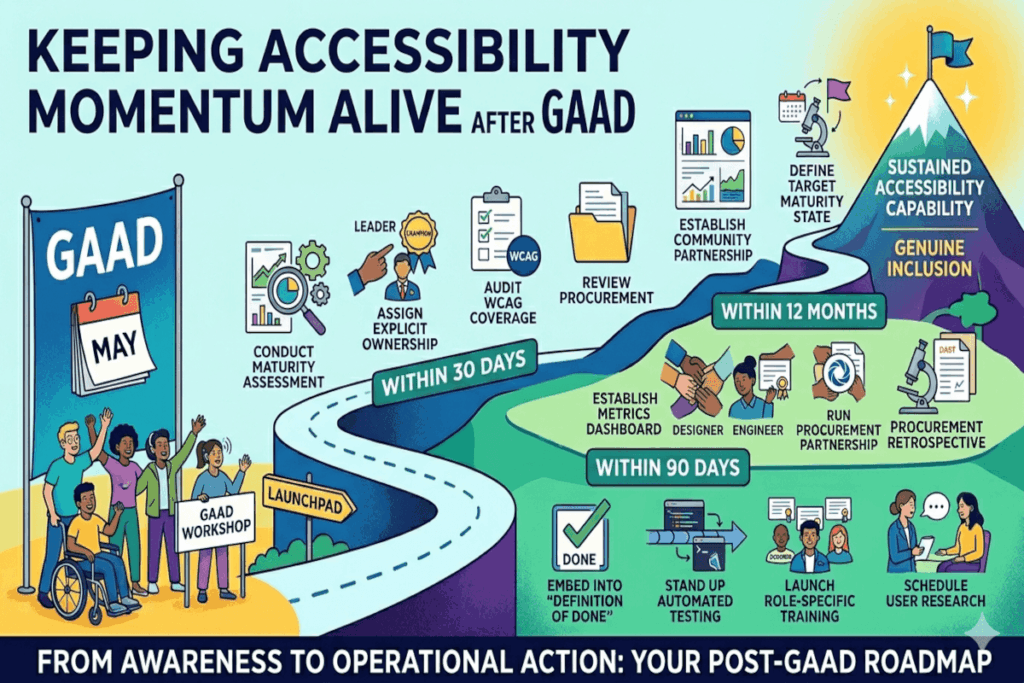
Your Post-GAAD Action Roadmap
Within the Next 30 Days
Conduct a maturity assessment if you have not already done one. Use the five-level framework we covered in this series to establish an honest baseline across governance, people, process, and technology. Identify the two or three dimensions where your organization is weakest and where improvement will produce the greatest real-world impact. Document the baseline so you have something to measure against in six months.
Assign explicit ownership. Accessibility cannot remain a shared responsibility that belongs to everyone in general and nobody in particular. Name the person or team that owns accessibility outcomes, give them the authority to set standards, and make that ownership visible to leadership.
Audit your WCAG coverage honestly. Review the products and journeys your team tested during the GAAD period. Map the gaps. Identify the critical user journeys that received no accessibility scrutiny and prioritize them for testing in the next sprint cycle.
Review your procurement pipeline. Identify any vendor evaluations scheduled in the next quarter and confirm that your accessibility evaluation framework will apply to each of them. If no framework exists, build a basic one now using the VPAT review process as the foundation.
Within the Next 90 Days
Embed accessibility into your definition of done. Work with engineering leads to add accessibility acceptance criteria to the development checklist for new features. This single structural change prevents new accessibility debt from accumulating while teams work on existing debt.
Stand up automated accessibility testing in your CI pipeline if it does not already run there. Automated scanning catches roughly 30 to 40 percent of accessibility issues but catches them early and consistently. Running it on every build creates a safety net that costs almost nothing to maintain once it is in place.
Launch role-specific training for design and engineering teams. Move away from generic awareness content toward training that connects directly to the daily decisions each discipline makes. Designers need inclusive design principles and WCAG annotation practices. Engineers need semantic HTML, ARIA implementation, and assistive technology testing skills. Make completion trackable and connect it to onboarding for new hires.
Schedule your first user research session with disabled participants. If your organization has never tested with disabled users, this is the highest-leverage action you can take to ground your accessibility work in real human experience. Partner with a disability-led research organization if you need support building the participant pipeline.
Within the Next 12 Months
Build an accessibility metrics dashboard that reaches leadership. Track defect trends over time, remediation velocity, training completion by role, component compliance rates, and audit coverage of critical journeys. Report these numbers to leadership on a quarterly cadence alongside performance and reliability metrics. Visibility creates accountability. Accountability creates sustained investment.
Establish a disability community partnership. Move beyond periodic usability testing toward an ongoing relationship with disability advocacy organizations and disabled users who can provide continuous input into your product roadmap. Organizations that treat disabled users as strategic partners rather than test subjects build products that are measurably better.
Run a procurement retrospective. Review every third-party tool and platform that entered your environment in the past 12 months. Assess whether each one met the accessibility standards your contracts required. Use the findings to strengthen your evaluation framework and your vendor management process.
Define your 12-month target maturity state. Using the baseline assessment you completed in month one, set a specific target for where you want to be across each maturity dimension by this time next year. Make the target concrete, make it visible to leadership, and review progress against it quarterly.
The Metric That Matters Most
Every action item above contributes to organizational capability. But the single most important indicator of whether your post-GAAD momentum is real is this: are disabled users finding your products easier to use than they were a year ago?
That question cuts through process compliance, training completion rates, and audit scores. It anchors every technical and organizational effort to the human outcome that justifies all of it. Build your measurement program around that question and everything else will orient correctly.
A Final Word on Sustaining the Work
GAAD exists because digital accessibility still requires a dedicated moment of attention to break through organizational inertia. The goal is to eventually make that moment unnecessary, to reach a point where accessibility is so embedded in how your organization thinks and builds that it requires no special occasion to keep it on the agenda.
That goal is achievable. The organizations that reach it do not do anything dramatically different from what this series described. They simply do it consistently, measure it honestly, and refuse to let the urgency of other priorities become a reason to let disabled users down.
The series ends here. The work does not.