Summary
This is an article in a series of articles on digital accessibility posted on Global Accessibility Awareness Day (GAAD) 2026. Want to celebrate and participate? Share this article with others in your digital world.
It’s Not a Moment, It’s a Movement
Global Accessibility Awareness Day, often referred to as GAAD, shows up on the calendar every May. But reducing it to a date misses the point entirely.
At its core, GAAD is a catalyst. It exists to spark awareness, yes, but more importantly, to convert that awareness into sustained action. It’s about shifting accessibility from a side conversation to a core business priority.
The real question isn’t “Did your organization acknowledge GAAD?”
It’s “What changed because of it?”
Awareness Is the Entry Point, Not the Outcome
The stated goal of GAAD is straightforward, get people talking, thinking, and learning about digital accessibility and inclusion. That matters. Many teams still lack even a baseline understanding of how accessibility impacts users and business outcomes.
But awareness, on its own, is inert.
Consider a common scenario: a company shares a few social posts, maybe hosts a webinar, and circulates an internal email about accessibility. Engagement spikes for a day, then everything returns to business as usual.
Nothing operational changes. No barriers are removed. No users benefit.
That’s the gap GAAD is meant to close.
Where GAAD Creates Real Impact
Organizations that extract real value from GAAD treat it as a launchpad. They use the visibility of the moment to initiate work that continues long after the day passes.
That typically shows up in a few concrete ways:
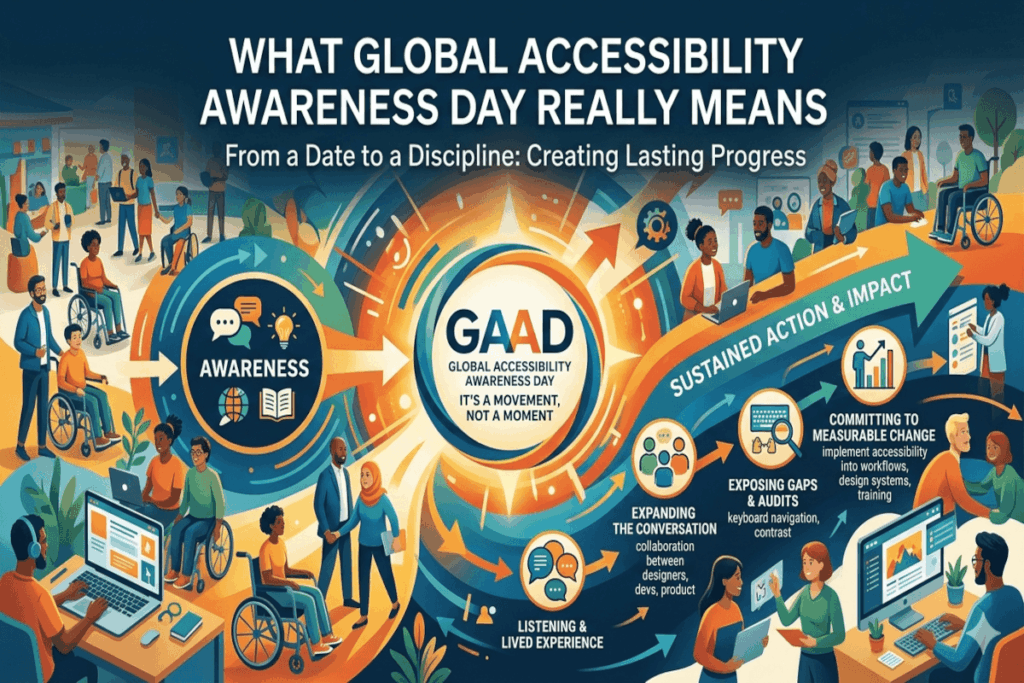
Expanding the Conversation
Teams that have never engaged with accessibility, engineering, product, marketing, legal, are brought into the discussion. For example, a product team might run its first accessibility-focused design review, uncovering issues with color contrast and keyboard navigation that had gone unnoticed.
Centering Lived Experience
Instead of speaking about accessibility in the abstract, organizations bring in real voices. This might mean hosting a session where screen reader users demonstrate how they navigate a site, revealing friction points that automated tools completely miss.
Exposing Gaps in Practice
GAAD is an ideal forcing function for honesty. A lightweight audit of a key user journey, such as checkout or account creation, often surfaces critical barriers. For instance, an e-commerce company may discover that its checkout flow cannot be completed without a mouse, effectively blocking keyboard-only users.
Committing to Measurable Change
The most mature organizations leave GAAD with defined next steps. Not vague intentions, but specific commitments, like integrating accessibility into their design system, requiring accessibility acceptance criteria in user stories, or scheduling quarterly audits.
What Meaningful Participation Actually Looks Like
If GAAD is treated as a strategic opportunity, participation becomes tangible.
- Run an accessibility audit on a high-impact workflow and prioritize remediation
- Launch targeted training for designers, developers, or content teams based on real gaps
- Fix a known barrier that has been deprioritized, such as missing form labels or inaccessible modals
- Embed accessibility into your roadmap, ensuring it is planned, resourced, and tracked
These are not theoretical exercises. They directly improve user experience and reduce organizational risk.
The Most Undervalued Practice: Listening
One of the most overlooked aspects of GAAD is also the most powerful, listening to people with disabilities.
No guideline, including WCAG, can fully capture the nuance of real user behavior. Direct engagement, usability testing, interviews, or feedback sessions, reveals insights that shift how teams think about design and development.
For example, a visually polished interface may technically meet contrast requirements but still feel unusable to a low-vision user due to cognitive load or layout complexity. That distinction only surfaces through lived experience.
From One Day to Ongoing Discipline
GAAD should create momentum, not closure.
The organizations that lead in accessibility are not the ones with the best one-day campaigns. They are the ones that operationalize accessibility, embedding it into design systems, development workflows, procurement, and governance.
They treat accessibility the same way they treat performance, security, or quality, as a continuous, measurable discipline.
Call to Action
Choose one meaningful action your organization can take today. Not next quarter, not “someday.”
Start an audit. Fix a critical issue. Train a team. Talk to users.
Then commit to carrying that action forward.
Because what Global Accessibility Awareness Day really means is this: progress that lasts beyond the moment.