Today marks the thirty-sixth anniversary of the Americans with Disabilities Act (ADA), a law that, in 1990, told 61 million Americans that the door was no longer allowed to be closed. Curb cuts, accessible transit, closed captioning, reasonable workplace accommodations: these are not abstractions. They are the daily infrastructure of independence for millions of people, and they exist because Congress once decided that equal access wasn’t a courtesy but a civil right.
That is worth celebrating. It is also, this year, worth defending.
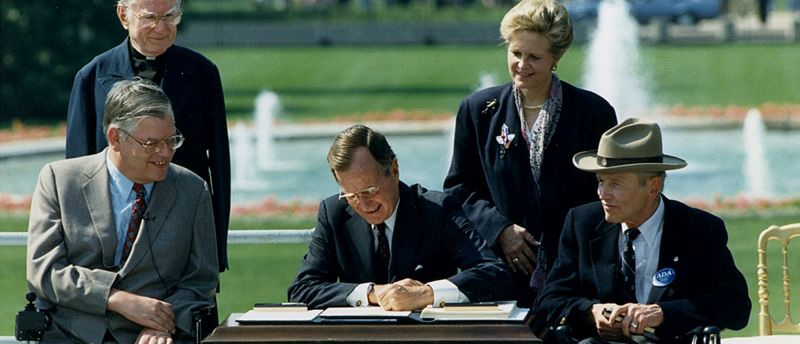
A Law Under Quiet Pressure
The ADA has never been self-enforcing. It has always depended on litigation, regulatory follow-through, and public will to give its promises teeth. What’s different now is the number of fronts on which that follow-through is being tested at once.
Federal agencies charged with ADA enforcement have seen staffing and funding pressures that slow investigations and delay accessibility rulemaking. Courts in several circuits have narrowed who can sue and for what, making it harder for disabled plaintiffs to hold noncompliant businesses and institutions accountable. And remote work, once framed as an accessibility breakthrough, has in many industries been rolled back through return-to-office mandates that quietly exclude workers for whom remote flexibility was not a perk but a prerequisite for employment at all.
Add to this a broader political climate skeptical of federal mandates on private business and state or local governments, and the ADA finds itself in an unusual position: a law with near-universal name recognition and shrinking practical muscle behind it.
Why This Moment Matters
None of this looks like repeal. That’s precisely the danger. Civil rights laws rarely die from a single dramatic vote, they erode through underfunded enforcement, narrowed interpretation, and the slow normalization of noncompliance. A ramp that’s “coming eventually.” A website redesign that “didn’t prioritize” screen-reader compatibility. An employer who treats accommodation requests as negotiable rather than required. Individually, these look like oversights. Collectively, they are how a right becomes optional.
Disabled Americans are not a monolith, and the ADA was never a finished project, even its strongest advocates have long pushed for stronger enforcement mechanisms and broader coverage. But there is a meaningful difference between a law being imperfectly ambitious and a law being actively hollowed out. What we’re seeing increasingly resembles the latter.
The Case for Confidence
And yet. The same coalition that won the ADA in 1990, disabled activists, allies, employers who understood accessibility as good business, and lawmakers across the aisle who saw equal access as a bipartisan value, still exists, and it is not idle.
Disability rights organizations continue to win landmark cases. Cities continue to invest in accessible infrastructure because accessible design is, increasingly, just good design. A new generation of technologists is building accessibility into products from day one rather than retrofitting it as an afterthought. And public awareness of what accessibility actually requires, not charity, but engineering, policy, and will, is arguably higher now than at any point since the law’s passage.
The ADA was never handed down from above. It was built by people who refused to accept that inaccessibility was simply how the world had to work, and who kept building even when the wins were incremental and the setbacks were real. That persistence is still the operating model. It doesn’t require optimism so much as it requires continued insistence, showing up at public comment periods, supporting the organizations litigating these cases, and refusing to let “coming eventually” be the final answer.
Thirty-six years in, the ADA is not what it once was, and it is not yet what it should be. But the people who wrote it into existence proved that access can be legislated, built, and defended, one curb cut, one lawsuit, one policy fight at a time. That work isn’t finished. It’s just continuing.
One thought on “Thirty-Six Years Later: The ADA at a Crossroads”