Most organizations frame accessibility as a yes-or-no question. They ask, “Are we accessible?” That framing gets them stuck. It is the wrong question, and the answer rarely moves the needle.
Accessibility is not a binary state you reach and then maintain. It is an evolving operational capability, one that organizations build, lose, and rebuild as their teams, tools, and products change. The question that actually drives progress is far more productive: how mature are we, and where do we need to grow?
What Accessibility Maturity Actually Means
Accessibility maturity reflects how consistently an organization delivers accessible outcomes over time. It goes far deeper than counting defects or tracking audit scores. Organizations that understand this distinction invest across a full range of interconnected dimensions: governance and policy, leadership commitment, skills and training, design and development practices, testing rigor, procurement controls, measurement and reporting, and continuous improvement.
Each of these dimensions reinforces the others. Strong governance without skilled practitioners produces paper compliance. Talented practitioners without executive backing produce isolated pockets of excellence. Maturity requires coherence across all of these areas simultaneously.
Level 1: Reactive Accessibility
Level 1 is where most organizations begin, and where more organizations currently operate than most accessibility professionals would like to admit. At this stage, accessibility work happens only when something forces it: a complaint, a legal threat, a public callout, or an escalation from a frustrated user.
The defining characteristic of Level 1 is that accessibility has no proactive home in the organization. Nobody owns it consistently. No process requires it. No budget funds it in advance. It exists as a fire to put out, not a capability to build.
What Level 1 Looks Like in Practice
- Governance and Policy There is no formal accessibility policy, or a policy exists on paper but nobody enforces it. Leadership has not defined what “accessible” means for the organization, who is responsible for it, or how compliance will be measured.
- Leadership Executives are aware of accessibility mainly as a legal risk. The conversation surfaces during contract renewals, procurement reviews, or after a complaint lands in the legal department. Between those moments, it disappears from the agenda entirely.
- Skills and Training Most designers, engineers, and product managers have received no meaningful accessibility training. Awareness varies widely and depends almost entirely on individual interest. The organization has not invested in building the skill systematically.
- Design and Development Practices Accessibility considerations do not enter the product lifecycle at any defined point. Teams build features, ship them, and discover accessibility failures after real users encounter them. Remediation happens under pressure and tends to be narrow, addressing only the specific complaint rather than the underlying systemic issue.
- Testing No structured accessibility testing process exists. Teams may run an automated scan before a major release, but manual testing, assistive technology testing, and testing with disabled users are absent. Automated scans catch roughly 30 to 40 percent of accessibility issues, meaning the majority go undetected until a user reports them.
- Procurement Third-party tools and platforms enter the environment without formal accessibility evaluation. Vendors are selected on features, price, and compatibility. Accessibility is rarely a question asked during procurement, and almost never a contractual requirement.
- Measurement There are no accessibility metrics, no defect tracking specific to accessibility, and no reporting that surfaces accessibility health to leadership. The organization has no visibility into how accessible its products actually are between complaint cycles.
The Hidden Cost of Staying at Level 1
Organizations often underestimate what Level 1 actually costs them. Reactive remediation is significantly more expensive than building accessibly from the start. Fixing an accessibility failure after a feature ships typically costs five to ten times more than addressing it during design. Legal exposure compounds over time. And the reputational damage that follows a public accessibility failure is difficult and slow to repair.
Beyond the financial calculation, Level 1 organizations actively exclude users with disabilities from their products. That is not a compliance abstraction. It is a real group of people who cannot use something they need.
The Most Common Barrier to Moving Forward
The primary obstacle at Level 1 is not technical knowledge. It is organizational will. Teams often know they have accessibility gaps. They lack the executive mandate, the dedicated resources, and the clear ownership structures that would allow them to act systematically rather than reactively.
The move from Level 1 to Level 2 does not require solving everything at once. It requires one committed leader willing to define ownership, fund a baseline assessment, and make accessibility a standing agenda item rather than an emergency response.
That single structural shift is what separates organizations that stay stuck at Level 1 from those that begin building genuine capability.
Level 2: Emerging Accessibility
Level 2 represents the first real signal that an organization has decided to take accessibility seriously. The purely reactive posture of Level 1 has begun to crack. Someone with influence has recognized that complaint-driven remediation is not sustainable, and the organization has started making its first deliberate investments.
The defining characteristic of Level 2 is intent without infrastructure. The will to improve exists, but the systems, processes, and accountability structures needed to make that improvement consistent and durable have not yet been built.
What Level 2 Looks Like in Practice
- Governance and Policy A basic accessibility policy may exist, often drafted in response to a legal review or a procurement requirement from a major client. However, the policy lacks enforcement mechanisms, defined ownership, and measurable standards. It states good intentions without creating operational obligations.
- Leadership One or two individuals, typically a senior product leader, a legal counsel, or a newly appointed accessibility champion, have begun advocating for change. Their commitment is genuine, but it has not yet translated into budget, headcount, or executive accountability structures. Accessibility competes for attention against every other priority and frequently loses.
- Skills and Training The organization has run its first accessibility training, usually a one-time workshop or an online module pushed to a broad audience. Attendance may be strong, but the training is not role-specific, not reinforced over time, and not connected to how people actually do their daily work. Awareness rises temporarily and then fades.
- Design and Development Practices Individual practitioners, usually designers or engineers who attended training or have a personal connection to disability, begin applying accessibility thinking to their own work. Their efforts produce real improvements in specific areas. But because these improvements depend on individual initiative rather than shared process, they are uneven. One product team builds accessibly while another does not. One designer annotates for screen readers while another has never considered it.
- Testing The organization begins running accessibility audits, typically engaging an external vendor for a point-in-time review before a major release or in response to an audit requirement. Automated scanning tools appear in some development workflows. Manual testing is occasional and inconsistent. Testing with disabled users remains rare or absent entirely.
- Procurement Accessibility starts appearing as a question in some vendor evaluations, often because a procurement team member attended training or a client contract required it. However, there is no formal evaluation framework, no consistent criteria, and no contractual language that holds vendors accountable for what they commit to.
- Measurement Some teams begin tracking accessibility defects, usually within existing bug tracking systems rather than through dedicated accessibility metrics. Reporting is informal and does not reach leadership in any structured way. The organization cannot yet answer the question of whether it is getting better or worse over time.
The Characteristic Tensions of Level 2
Organizations at Level 2 frequently experience the same frustrations. Champions do the work but burn out because the organization has not built the infrastructure to sustain their efforts. Training happens but does not change behavior because it is disconnected from process. Audits surface defects but remediation stalls because no team owns the backlog or has capacity allocated to address it.
The most common failure mode at Level 2 is cycling. An organization invests in a burst of activity, makes visible progress, and then allows that progress to erode as priorities shift and champions move on. A year later, a new audit reveals that the same categories of issues have returned. The effort was real but the gains were not durable because nothing structural changed.
What It Takes to Move to Level 3
The gap between Level 2 and Level 3 is fundamentally a gap between individual effort and institutional process. Crossing it requires the organization to make three structural commitments.
First, it needs to define clear ownership. Accessibility cannot live as a shared responsibility that belongs to everyone in general and nobody in particular. Someone needs an explicit mandate, dedicated time, and the authority to set standards and hold teams accountable.
Second, it needs to embed accessibility into existing workflows rather than running it as a parallel track. That means accessibility criteria entering design reviews, development checklists, and definition-of-done criteria. It means automated testing running in CI pipelines, not just in pre-release audits.
Third, it needs to establish baseline metrics and report them to leadership on a regular cadence. Without visibility, accessibility remains optional. With visibility, it becomes a performance dimension that leaders can track, question, and act on.
None of these steps require perfection. They require consistency. And consistency is precisely what separates Level 2 from Level 3.
Level 3: Defined Accessibility
Level 3 is the most consequential transition in the maturity model. Organizations that reach it have crossed the line from good intentions and individual heroics into something genuinely institutional. Accessibility now lives in the organization’s operating model, not just in the hearts of its champions.
The defining characteristic of Level 3 is repeatability. The organization can deliver accessible outcomes not because the right people happen to be in the room, but because the right processes are built into how work gets done. A new team member joining a Level 3 organization encounters accessibility expectations from day one. A new product launching in a Level 3 organization passes through accessibility checkpoints as a matter of course.
That shift from dependent to systematic is what makes Level 3 the foundation everything else builds on.
What Level 3 Looks Like in Practice
- Governance and Policy The organization maintains a formal, enforced accessibility policy that references recognized standards, typically WCAG 2.1 or 2.2 at AA conformance, and defines what compliance means for different product types. The policy assigns clear ownership, specifies consequences for non-compliance, and is reviewed on a regular schedule. It is not a document that lives in a shared drive and gets cited only during audits. It actively shapes how teams make decisions.
- Leadership Accessibility has secured a consistent place on the product and technology leadership agenda. At least one senior leader carries explicit accountability for accessibility outcomes, with that accountability reflected in their performance objectives. Budget for accessibility tooling, training, and testing exists as a line item rather than something cobbled together from discretionary funds.
- Skills and Training Training has become role-specific and structured. Designers receive training grounded in inclusive design principles and WCAG criteria relevant to their discipline. Engineers learn how to implement accessible components, use semantic HTML correctly, and test with assistive technologies. Product managers understand how to write acceptance criteria that include accessibility requirements. New hires complete accessibility orientation as part of onboarding. Refresher training runs on a defined cycle.
- Design and Development Practices Accessibility requirements enter the product lifecycle at the discovery and design stage, not during QA. Design systems include accessible components with documented usage guidance. Designers annotate accessibility intent, covering focus order, landmark regions, alternative text, and interaction patterns, before work moves to engineering. Development teams work from defined coding standards that specify how to implement accessibility correctly. Definition-of-done criteria include accessibility checkpoints that prevent inaccessible features from shipping.
- Testing A structured, multi-layered testing approach operates across the development cycle. Automated scanning runs continuously in CI pipelines, catching detectable issues early. Manual testing covers interaction patterns and WCAG criteria that automation cannot assess. Teams test with a defined set of assistive technology and browser combinations. Some organizations at Level 3 begin incorporating periodic testing with disabled users, though this tends to be more systematic at Level 4.
- Procurement The organization applies a formal accessibility evaluation framework to third-party tools and platforms before purchase decisions are finalized. Vendors provide Accessibility Conformance Reports based on VPAT documentation. Procurement contracts include accessibility warranty clauses and remediation obligations. Teams responsible for evaluating vendors understand how to read and challenge conformance claims rather than accepting them at face value.
- Measurement Accessibility metrics exist and are tracked systematically. Teams monitor defect counts and trends, time to remediate, audit coverage, and training completion rates by role. Reports reach leadership on a regular cadence. The organization can now answer the question it could not answer at Level 2: are we getting better or worse, and where specifically are the gaps?
The Characteristic Strengths of Level 3
Organizations at Level 3 have solved the sustainability problem that defeats so many Level 2 organizations. Progress no longer depends on individual champions maintaining their energy and organizational influence. When a champion leaves, the processes they built continue operating. When a new product team forms, they inherit the same standards and workflows as every other team.
This institutional durability is enormously valuable. It transforms accessibility from a campaign into a capability.
Level 3 organizations also tend to find that accessibility improvements compound. When design systems carry accessible components, every team that uses those components benefits automatically. When CI pipelines catch regressions, issues never accumulate into the kind of debt that requires a dedicated remediation sprint to clear.
The Characteristic Tensions of Level 3
The limitations of Level 3 become visible precisely because the processes are now good enough to generate real data. That data tends to reveal uncomfortable truths: certain product areas consistently underperform, certain teams move through accessibility checkpoints without genuinely engaging them, certain defect categories persist across release cycles.
The challenge at Level 3 is that processes exist but accountability for outcomes remains uneven. A team can technically satisfy every checkpoint and still ship a product that creates significant barriers for users with disabilities. Process compliance and genuine accessibility quality are not the same thing, and Level 3 organizations are often just beginning to grapple with that distinction.
The other tension involves coverage. Defined processes cover the products and journeys that teams thought to include when the processes were designed. Edge cases, legacy systems, third-party integrations, and rapidly shipped features frequently fall outside the established framework. Audit coverage at Level 3 tends to be strong on flagship journeys and weak on everything else.
What It Takes to Move to Level 4
The move from Level 3 to Level 4 requires the organization to shift its focus from process compliance to outcome accountability. Three capabilities drive that transition.
The organization needs to build a metrics infrastructure that goes beyond tracking inputs like training completion and audit coverage, and starts measuring outputs: actual conformance rates across product surfaces, user satisfaction among people with disabilities, regression rates between releases, and remediation velocity by team and defect type.
It needs to connect those metrics to real accountability. Leaders at the team and product level need to own accessibility outcomes the way they own reliability or performance outcomes, with visibility into their numbers, expectations for improvement, and consequences when things regress without explanation.
And it needs to close the coverage gaps that defined processes inevitably leave open, through risk-based prioritization that ensures the most critical user journeys receive the deepest scrutiny, regardless of whether they were included in the original process design.
Level 3 is a genuine achievement. It is also the stage where organizations discover that building the infrastructure was the easier half of the work. The harder half is using it to drive outcomes rather than to demonstrate effort.
Level 4: Managed Accessibility
Level 4 represents the point where accessibility stops being something an organization does and starts being something an organization measures, manages, and improves with the same discipline it applies to its most critical operational capabilities. The processes built at Level 3 now generate real data, and that data actively drives decisions.
The defining characteristic of Level 4 is accountability anchored in evidence. Leaders do not rely on gut feel or audit snapshots to understand their accessibility posture. They track trends, investigate anomalies, compare performance across teams and product surfaces, and hold people responsible for outcomes rather than just activities.
This shift from process compliance to outcome accountability is what separates organizations that are genuinely accessible from those that are merely organized about trying.
What Level 4 Looks Like in Practice
- Governance and Policy Governance at Level 4 operates as a live management system rather than a static policy framework. Accessibility standards are versioned and updated in response to new WCAG guidance, platform changes, and emerging assistive technology behaviors. Governance bodies include representatives from design, engineering, product, legal, and procurement, and they meet regularly to review performance data, adjudicate exceptions, and set priorities. Exceptions to accessibility standards require formal approval, documented rationale, and a defined remediation timeline. The organization tracks those exceptions and follows up on them.
- Leadership Accessibility metrics appear on executive dashboards alongside performance, reliability, and security indicators. Senior leaders ask about accessibility trends in business reviews the same way they ask about uptime or customer satisfaction scores. Individual product and engineering leaders carry accessibility targets in their objectives, and those targets connect meaningfully to how their performance is evaluated. Accessibility has moved from a legal risk managed by the compliance team to a product quality dimension managed by the people who build and ship products.
- Skills and Training The organization has moved beyond standardized training curricula into something more sophisticated. Training effectiveness is measured, not just completion. Role-specific competency frameworks define what accessibility knowledge and skill each discipline needs at each career level. Senior designers and engineers are expected to mentor junior colleagues on accessibility practice. Accessibility specialists serve as embedded advisors to product teams rather than a separate audit function teams engage only when something breaks.
- Design and Development Practices Accessibility is a first-class quality gate, not a checkpoint teams work around. Design reviews include structured accessibility critique against defined criteria. Pull request processes require accessibility sign-off for components and interaction patterns that affect users with disabilities. Engineering teams own their accessibility defect backlogs and track remediation velocity. Product roadmaps allocate explicit capacity for accessibility improvements, not just new feature development. Regression testing catches accessibility degradations before they reach production.
- Testing Testing at Level 4 is comprehensive, continuous, and user-centered. Automated scanning covers the full product surface and runs on every build. Manual testing protocols address the gaps automation cannot cover, including cognitive accessibility, complex interaction patterns, and dynamic content behaviors. The organization conducts regular research and usability testing with disabled users across a range of disability types and assistive technology configurations. Findings from user research feed directly into product and design decisions, not just compliance remediation.
- Procurement Vendor accessibility evaluation has matured from a checklist exercise into a substantive technical assessment. Procurement teams evaluate vendor VPATs critically, testing claims against actual product behavior rather than accepting documentation at face value. Contracts include specific conformance targets, audit rights, and remediation obligations with defined timelines and escalation paths. Vendor accessibility performance is reviewed regularly and factors into renewal decisions.
- Measurement A sophisticated accessibility metrics program operates across the full product portfolio. The organization tracks conformance rates by product, team, and issue category. It measures remediation velocity, regression rates, audit coverage depth, and user satisfaction among people with disabilities. Trend data enables the organization to distinguish between teams making genuine progress and teams managing their numbers without improving their outcomes. Leadership receives regular accessibility performance reports with enough granularity to identify where intervention is needed.
The Characteristic Strengths of Level 4
The most important strength Level 4 organizations develop is the ability to see reality clearly. Earlier maturity levels operate with significant blind spots. Level 1 organizations discover problems only when users complain. Level 2 and 3 organizations discover problems when audits surface them. Level 4 organizations monitor their accessibility health continuously and catch degradations early, before they compound into systemic failures requiring expensive remediation campaigns.
This visibility creates a fundamentally different relationship with risk. Rather than managing accessibility as a liability that might surface unexpectedly, Level 4 organizations understand their exposure at any given moment. They know which product areas carry the most significant accessibility debt, which teams are improving fastest, and where the next critical audit finding is most likely to emerge. That knowledge allows them to allocate resources proactively rather than reactively.
Level 4 organizations also tend to build genuine institutional knowledge about what works. Because they measure outcomes systematically, they accumulate evidence about which interventions drive the most meaningful improvement. They know whether their training programs change behavior. They know which testing methods surface the issues that matter most to users. They can distinguish between activities that produce results and activities that produce the appearance of results.
The Characteristic Tensions of Level 4
The central tension at Level 4 involves the gap between metric performance and user experience. Organizations that manage accessibility through metrics can drift toward optimizing the metrics rather than optimizing for disabled users. A team that maintains a strong audit pass rate while never actually testing with disabled users may be measuring the wrong things very carefully.
The other significant tension involves the organizational weight that a mature accessibility program accumulates. Governance processes, review gates, documentation requirements, and reporting cadences all consume time and attention. Teams that have internalized accessibility deeply sometimes find the formal overhead of a Level 4 program more burdensome than helpful. Managing that tension, keeping the infrastructure lean enough to accelerate teams rather than slow them down, requires continuous attention and a willingness to simplify processes that have outlived their purpose.
There is also the question of coverage depth versus coverage breadth. Level 4 organizations typically achieve strong coverage across flagship products and critical user journeys. Less visible product surfaces, internal tools, legacy systems, and rapidly shipped experimental features frequently receive less rigorous treatment. Genuinely managing accessibility at Level 4 requires honest accounting of what the measurement program actually covers and what it does not.
What It Takes to Move to Level 5
The gap between Level 4 and Level 5 is more cultural than structural. The infrastructure, the processes, the metrics, and the accountability mechanisms are largely in place. What remains is the final shift from managed compliance to embedded values.
Level 5 requires the organization to stop experiencing accessibility as an obligation it fulfills and start experiencing it as an expression of what the organization believes about the people it serves. That shift shows up in specific behaviors: designers who raise accessibility concerns before anyone asks them to, engineers who push back on timelines that would require shipping inaccessible features, executives who treat accessibility regression the same way they treat a security breach.
It also requires the organization to deepen its relationship with the disability community beyond usability testing. Level 5 organizations employ people with disabilities across their product, design, and engineering functions. They engage disability advocates as ongoing strategic partners rather than periodic consultants. They contribute to accessibility standards development rather than simply implementing standards others created.
Getting there from Level 4 means looking honestly at the distance between where metrics say the organization is and where the experience of disabled users says it actually is, and treating that gap as the most important number on the dashboard.
Level 5: Optimized Accessibility
Reaching Level 5 means your organization has crossed a fundamental threshold. Accessibility is no longer a workstream, a compliance requirement, or a remediation cycle. It is part of how your organization thinks, builds, and operates by default.
Here is what that looks like in practice across each dimension:
- Governance and Policy Policies are living documents, regularly reviewed and updated in response to new standards, user research, and product changes. Accessibility obligations sit at the board or executive level, not just in a compliance or legal function.
- Leadership Commitment Senior leaders actively sponsor accessibility initiatives, include accessibility metrics in business reviews, and hold product and engineering leaders accountable for outcomes. It is not delegated and forgotten.
- Skills and Training Role-specific training is embedded in onboarding and updated continuously. Designers know inclusive design principles instinctively. Engineers catch accessibility issues before they write a line of code. Accessibility is not a specialty skill; it is a baseline expectation across every discipline.
- Design and Development Practices Accessibility requirements enter the product lifecycle at the earliest stages, during discovery and ideation, not during QA. Design systems carry accessibility baked in. Component libraries are tested, documented, and maintained with accessibility as a first-class property.
- Testing Rigor Automated, manual, and user testing with disabled participants run continuously, not just at release time. Testing covers the full range of assistive technologies and disability types. Defects are caught early, remediated fast, and tracked systematically.
- Procurement Controls Before any third-party tool or platform enters your environment, it clears a formal accessibility evaluation. Vendors are contractually required to meet standards, and you hold them to it.
- Measurement and Reporting Dashboards surface accessibility health in real time. Trends are visible, anomalies are flagged early, and leadership sees accessibility data alongside performance, reliability, and security metrics.
- Continuous Improvement Your organization does not wait for audits or complaints to identify gaps. It runs regular retrospectives, monitors emerging standards, engages the disability community as ongoing partners, and feeds those insights back into product and process decisions.
The Honest Reality
Very few organizations genuinely operate at Level 5 across all dimensions simultaneously. The ones that come closest share one distinguishing characteristic: they treat accessibility as a product quality dimension on par with performance and security, with the same investment, the same accountability structures, and the same intolerance for regression.
Getting to Level 5 is not a destination you arrive at and maintain effortlessly. It requires sustained organizational will, ongoing investment, and a culture that sees accessibility as inseparable from building good products.
The practical implication: if you are at Level 3 or 4, the gap to Level 5 is not primarily a technical one. It is cultural and structural. Close that gap first, and the technical excellence tends to follow.
Navigating the Five Levels
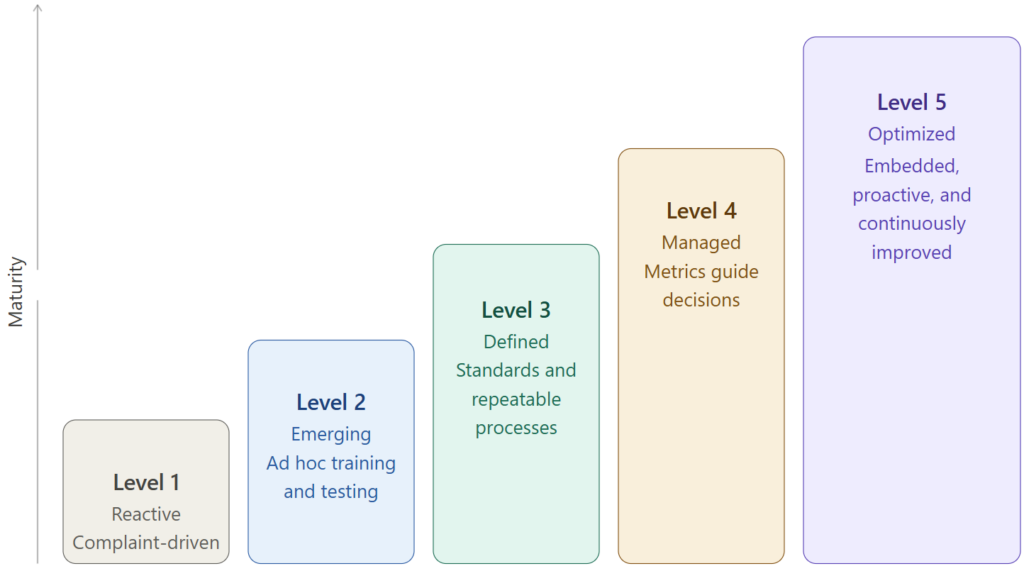
A practical maturity model gives organizations a shared language for where they are and where they need to go. The five levels above represent a progression, not a checklist. Organizations at Level 1 address accessibility only after complaints force their hand. At Level 2, some training exists and testing happens sporadically. Level 3 organizations operate with defined standards, clear roles, and repeatable processes baked into how teams work. Level 4 organizations use metrics to guide decisions and hold people accountable. At Level 5, accessibility becomes embedded in organizational culture, proactive rather than reactive, and subject to continuous improvement.
Most organizations will recognize themselves somewhere in the middle of this spectrum. That is exactly where the work happens.
Choosing Metrics That Create Accountability
Measuring maturity requires choosing indicators that actually reveal capability, not indicators that flatter your scorecards. Leaders who want an honest picture track defect trends over time, the speed with which teams remediate issues, training completion rates broken down by role, component compliance rates across design systems, audit coverage of critical user journeys, and direct feedback from users with disabilities.
Vanity metrics are the enemy of progress here. A rising audit pass rate means little if your team only tests the pages most likely to pass. A high training completion number is hollow if the training does not change how designers and developers make decisions. The metrics that matter are the ones that capture real capability, not surface compliance.
Why Maturity Models Shift the Conversation
The most valuable thing a maturity model does is change what organizations talk about. It replaces the perfection-seeking question (“are we compliant?”) with a progress-oriented one (“are we getting better?”). That shift enables realistic planning conversations, gives executives something meaningful to track, and creates space for teams to acknowledge gaps without treating those gaps as failures.
Organizations that adopt this framing stop treating accessibility as a liability to manage and start treating it as a capability to build. That change in orientation is what separates organizations that make consistent progress from those that cycle through the same remediation work year after year.
Starting With an Honest Baseline
Every organization that conducts a maturity assessment discovers the same thing: they are stronger in some dimensions than others. This is completely normal and expected. A team might have excellent testing practices but weak procurement controls. Leadership might be committed but skills across product teams remain uneven.
The goal is not to score well across every dimension on paper. The goal is to build genuine capability in practice, starting from an accurate understanding of where things actually stand today.
Your Next Step
Conduct a maturity assessment across four domains: governance, people, process, and technology. Be honest about the gaps. Then define a clear target state for the next 12 months, prioritizing the two or three dimensions where improvement will produce the greatest real-world impact.