Summary
This is an article in a series of articles on digital accessibility posted on Global Accessibility Awareness Day (GAAD) 2026. Want to celebrate and participate? Share this article with others in your digital world.
Technology is a tool, not a destination. Organizations that achieve meaningful, lasting accessibility do so because they build cultures that demand it.
Strong accessibility cultures improve decision-making at every level. Teams that internalize accessibility collaborate more effectively, catch problems earlier, and sustain progress without constant external pressure. Culture, not compliance, is the engine.
What Accessibility Culture Looks Like in Practice
Mature organizations treat accessibility as a baseline expectation. Teams understand their specific role in outcomes and address issues constructively, without defensiveness. Leadership reinforces accountability at every level. People learn continuously. Organizations measure success by the quality of user experience, not by whether they cleared an audit.
When accessibility becomes part of how an organization defines quality, it stops being a special project and starts being the way work gets done.
Awareness Is a Starting Line, Not a Finish Line
Many organizations run awareness campaigns and mistake visibility for progress. Awareness matters, but it only creates change when teams convert it into consistent action.
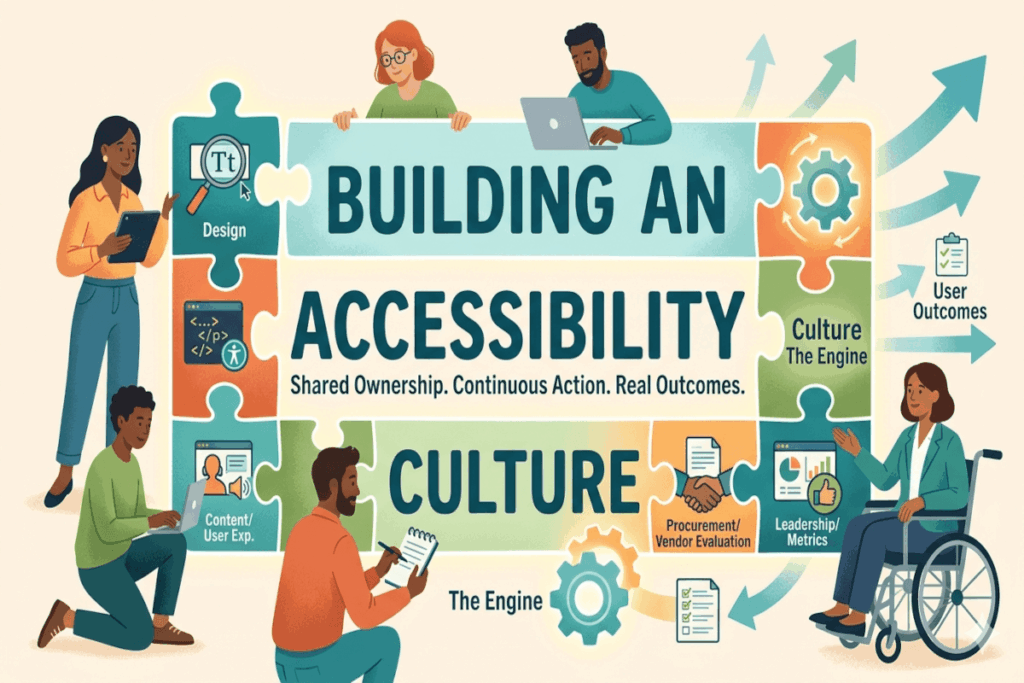
Designers who bring accessibility into critique sessions, engineers who test keyboard flows before shipping, content teams who follow accessible authoring standards, procurement teams who require accessibility in vendor evaluations, and leaders who ask for progress metrics regularly: these behaviors, not posters in the hallway, signal that a culture is taking hold.
Shared Ownership Drives Real Progress
When organizations assign accessibility to a single specialist team with limited authority, they set that team up to fail. Every function carries responsibility. Designers, engineers, writers, procurement professionals, legal teams, and product managers each influence outcomes.
Specialist teams play a critical role, but their job is to provide guidance and governance, not to absorb all accountability. Distributing ownership makes accessibility resilient instead of fragile.
Recognizing the Right Behaviors Shapes the Culture
What gets recognized gets repeated. Organizations that celebrate only audit-passing miss the point entirely. The teams worth recognizing are those that prevent issues before they ship, improve user outcomes in measurable ways, and mature their own processes over time.
Shifting recognition toward prevention sends a clear message: we care about the experience people actually have, not just the paperwork trail.
Leadership Signals Define What Teams Take Seriously
Employees pay close attention to what leaders fund, ask about, and prioritize. When accessibility appears only during crises or compliance reviews, the culture responds accordingly. It stays reactive.
Leaders who ask about accessibility metrics in regular reviews, who fund inclusive design from the start of a project, and who talk publicly about user outcomes embed accessibility into the fabric of how the organization operates.
Your Next Step
Identify one recurring meeting, workflow, or KPI where accessibility is currently absent. Make it a standing agenda item. That single shift sends a signal, creates accountability, and begins to move the culture.
Accessibility culture does not arrive all at once. It builds through consistent, visible choices, and it starts with the decision to make today’s meeting matter.