Summary
This is an article in a series of articles on digital accessibility posted on Global Accessibility Awareness Day (GAAD) 2026. Want to celebrate and participate? Share this article with others in your digital world.
Accessibility is not a feature you ship once. Building accessible design systems is how organizations transform it from a recurring remediation task into a foundational engineering discipline that every screen, every interaction, and every team consistently upholds. Yet most organizations continue treating accessibility as a line item in their backlog rather than a structural commitment. The result is predictable: the same broken patterns appear in product after product, the same audits surface the same findings, and teams implement the same fixes in isolation.
The Cost of Building Without a System
To understand why design systems matter so much for accessibility, consider what happens in their absence. Without a centralized component library, individual product teams build their own buttons, modals, forms, navigation patterns, and interactive controls. Each team makes its own decisions. Some get it right. Many do not. And the failures rarely stay isolated: a broken focus management pattern in one product typically exists in five others because each team recreated it from scratch.
This is not a failure of effort or intention. It is a structural problem. Organizations cannot expect developers to independently arrive at correct ARIA implementations, keyboard interaction patterns, or contrast-compliant color choices every time they build something new. The cognitive load is too high and the context too fragmented.
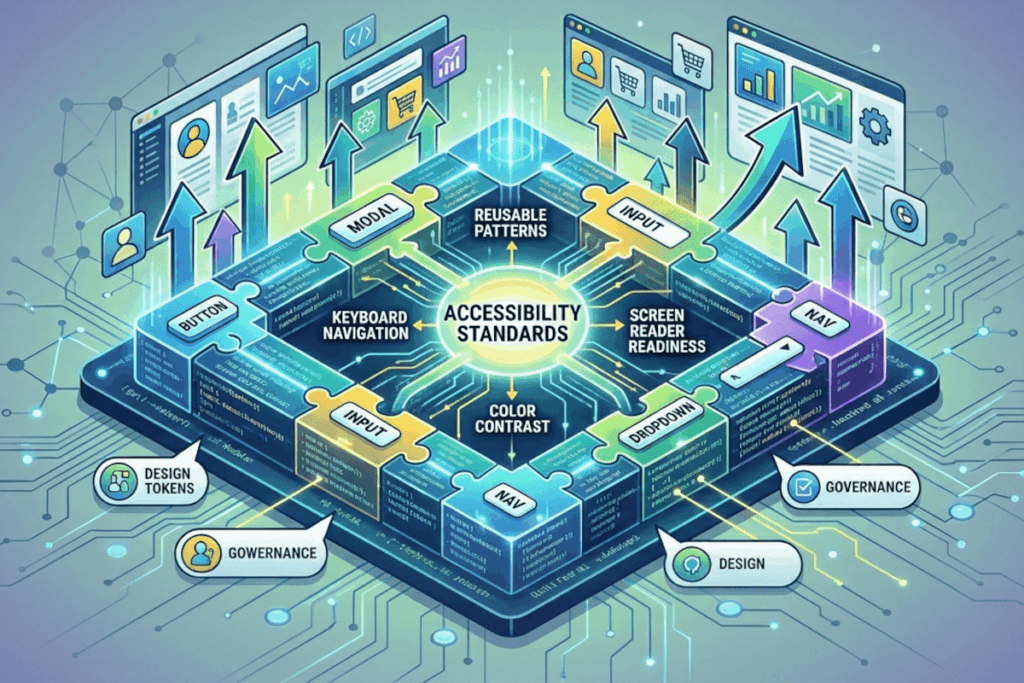
A well-constructed design system solves this by shifting accessible expertise upstream. People with the right knowledge define the interaction patterns, the keyboard behaviors, and the screen reader expectations once, then make them available to everyone. The result delivers consistent interaction patterns across products, reusable accessible components that teams deploy with confidence, faster delivery cycles that do not require each team to rediscover the same solutions, meaningfully reduced remediation costs, and shared standards that travel with every component.
Accessibility Cannot Be Treated as Documentation
Here is where many organizations fall short even after investing in a design system: they document accessibility requirements in a side section of their component specs and consider the obligation fulfilled. This fundamentally misunderstands the role a design system should play.
Accessibility requirements are not supplementary guidance. They are component specifications. Every component in a mature design system needs explicit, testable definitions. Keyboard behavior must specify which keys activate which functions and how focus moves through composite widgets. Designers and engineers must make focus states visible, intentional, and protected from CSS resets. Component APIs must define labels and accessible names, not leave them as implementation afterthoughts. Teams must design error handling to communicate meaning to assistive technologies, not just visually.
The list continues. Teams should test responsive behavior across zoom levels and viewport widths. The token layer should enforce contrast requirements rather than leaving them to each team’s judgment. Component specifications should define screen reader expectations, including announcements, roles, and state changes, so teams understand what a correct implementation looks and sounds like.
When requirements are predefined and embedded in the component itself, product teams stop guessing. They inherit a decision that someone already made correctly.
Foundations Determine Everything Built Above Them
Accessibility does not begin at the component layer. It begins at the foundation layer, and organizations that skip this step will find themselves fighting upstream problems in every component they build.
Design tokens are the clearest example. A token system that encodes contrast-safe color pairings eliminates an entire category of accessibility failure from the component development process. Typographic scales that account for readability at various sizes and weights, combined with line height and spacing values that support cognitive clarity, create a baseline that all components inherit. Spacing tokens calibrated for touch target sizes ensure that interactive elements meet minimum size requirements without requiring individual teams to calculate them manually.
Motion is another area where tokens provide structural protection. Defining animation and transition behaviors that respect the prefers-reduced-motion media query at the foundation level means every component built on that foundation automatically honors the user’s stated preference. Teams should not solve this component by component. They should solve it once, in the foundation.
The principle at work here is compounding leverage. Foundations influence everything built above them, which means every investment at the token and foundation level multiplies across the entire system.
Governance Is What Separates Durable Systems from Deteriorating Ones
Even an exceptionally well-built design system will degrade without governance. This is one of the most important and underappreciated truths in design systems work. Systems do not maintain themselves. They require active stewardship.
Durable organizations define contribution standards that specify what a component must include, including accessibility criteria, before it enters the system. They establish accessibility review processes that function as genuine gates rather than optional checklists. They maintain versioning and release discipline so teams can rely on consistent behavior over time. And they assign clear ownership roles so accountability does not diffuse into ambiguity.
Governance is not bureaucracy. It is quality infrastructure. Without it, individual teams gradually introduce inconsistencies, design decisions made without full context override accessible patterns, and the system slowly stops functioning as a source of truth. Organizations that invest in governance are investing in the system’s continued relevance.
Measuring Adoption Is the Real Metric
Many organizations take pride in having a design system while remaining largely indifferent to whether teams actually use it. A design system that exists but goes unadopted does not scale accessibility. It scales the appearance of having done something about accessibility.
Adoption is the metric that matters: how many products pull components from the system, how consistently teams implement those components without modification, and whether the people the system serves actually trust it. Teams adopt systems they trust and fork systems they do not.
This means design system teams carry an obligation not just to build well, but to listen, document, iterate, and demonstrate that the system is working. Accessibility adoption follows the same pattern. When accessible components are well-documented, easy to implement, and visibly supported by leadership, teams use them. When they are buried in an afterthought section of a documentation site, teams ignore them.
From Reactive Cleanup to Proactive Quality Engineering
The most significant shift that a mature, accessibility-informed design system enables is a change in how organizations relate to accessibility work itself. Instead of reacting to audit findings after products reach production, organizations that invest in accessible design systems practice proactive quality engineering.
They make the correct decision upstream, distribute it everywhere, and trust the system to carry that decision into every product built on it. Remediation still happens, but it becomes the exception rather than the rule. And when a team finds a problem in a shared component, fixing it once propagates that fix to every product depending on it. That is the compounding return on a well-maintained design system.
The practical starting point is straightforward: audit your ten most widely reused components. Identify which patterns appear across the greatest number of products. Prioritize remediating those patterns first. A fix applied to a button component used across twenty products is not one fix. It is twenty.
That is how accessibility at scale actually works.