Summary
This is an article in a series of articles on digital accessibility posted on Global Accessibility Awareness Day (GAAD) 2026. Want to celebrate and participate? Share this article with others in your digital world.
Artificial intelligence is no longer a distant concept reshaping industries from the outside. It is embedded in the products people use daily, the workflows teams depend on, and the customer experiences organizations stake their reputations on. And as AI becomes more pervasive, its relationship with accessibility grows more consequential, for better and for worse.
The organizations that understand this relationship early will build more durable, more equitable, and ultimately more competitive products. Those that ignore it risk encoding exclusion at a scale previously impossible.
The Genuine Promise of AI-Enabled Accessibility
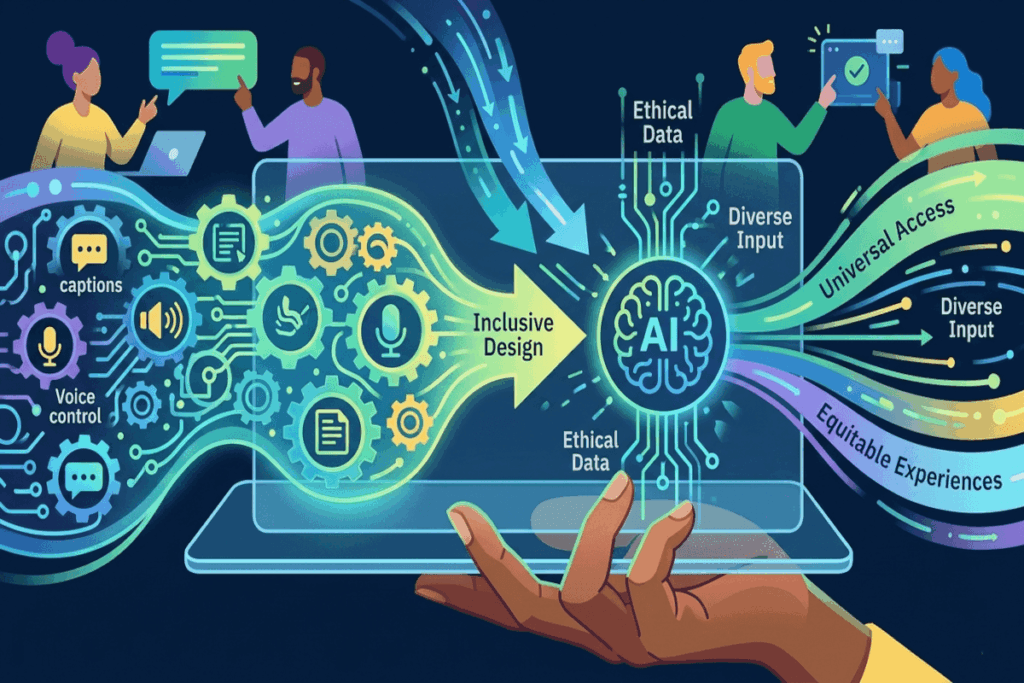
Let’s be clear about something that often gets lost in cautionary conversations: AI is already delivering meaningful accessibility gains. Automated captioning and transcription are making audio content reachable for deaf and hard-of-hearing users at a pace and cost that human transcription alone could never match. Draft alt text generation is helping teams surface image descriptions that would otherwise be skipped entirely. Voice interaction and speech recognition are giving users with motor impairments new pathways into digital experiences. Reading assistance and summarization tools are supporting users with cognitive disabilities or low literacy. Pattern detection in accessibility audits is surfacing issues that manual reviews miss.
These are not trivial improvements. They represent a genuine democratization of access, provided the technology is deployed thoughtfully.
The key phrase is thoughtfully. Because the same capabilities that accelerate inclusion can, when mishandled, industrialize exclusion.
The Risks That Scale Quietly
Here is the part of the AI accessibility conversation that deserves more attention in boardrooms and product reviews: errors do not stay small when AI is involved. They propagate.
A single piece of incorrectly generated alt text is a minor inconvenience. A model that consistently produces vague or inaccurate image descriptions, deployed across thousands of product pages, is a systemic barrier. Captions with critical errors do not just frustrate individual users; they sever access entirely for people who depend on them. Interfaces built around unpredictable conversational flows create environments where assistive technologies struggle to navigate reliably. Biased training data produces outputs that exclude certain user groups in ways that are difficult to detect and even harder to remediate at scale.
Dynamic content changes driven by AI can disrupt screen readers mid-interaction. Overreliance on automation, without human review built into the process, means these problems compound quietly until they become public failures or legal liabilities.
This is the paradox of AI and accessibility: the speed and scale that make AI valuable are the same properties that make its failures consequential.
Accessibility Belongs in the AI Lifecycle, Not After It
The most expensive accessibility fix is the one applied after launch. Yet most organizations still treat accessibility as a post-development checklist rather than a design constraint.
With AI-powered products, this tendency becomes actively dangerous. Accessibility considerations must be integrated across the full lifecycle: in model selection, where bias and output quality vary significantly; in product design, where interaction paradigms must account for diverse user needs from the start; in prompt architecture, where the instructions given to AI systems shape the inclusivity of their outputs; in interface behavior, where dynamic and generative content must be tested against assistive technology; in quality assurance, where automated testing must be supplemented with real user feedback; and in ongoing monitoring, where drift in model behavior can silently degrade accessibility over time.
Waiting until launch to ask whether a product is accessible is not a strategy. It is a liability.
The Case for Human Oversight
There is a temptation in AI-forward organizations to treat automation as the destination. It is not. It is a tool.
Generated alt text may be a reasonable starting point, but whether it is genuinely helpful depends on context that a model often cannot fully interpret. A chart showing quarterly revenue requires different descriptive logic than a portrait or a product photo. A screen reader user navigating a financial dashboard has different needs than one reading a news article. Human expertise, informed by real user testing and disability community input, remains irreplaceable in making these distinctions well.
AI can make accessibility work faster. It cannot yet make it complete.
The Strategic Opportunity Is Real
Accessibility and AI innovation are not competing priorities. They are complementary ones, and the organizations that treat them that way will have a structural advantage.
Building inclusive AI is not just an ethical position. It is a design discipline that produces cleaner architectures, clearer interfaces, and more resilient products. It expands addressable markets. It reduces legal exposure. It builds the kind of trust with users that performance metrics alone cannot generate.
The organizations chasing AI novelty without accessibility governance are taking on technical debt and reputational risk simultaneously. The ones that build accessibility into their AI practice from the beginning are compounding trust with every release.
Call to Action: Before deploying any new AI-powered user experience, build an AI accessibility review checklist into your launch criteria. Define who reviews generated content for accuracy, how assistive technology compatibility is tested, and what thresholds trigger human escalation. Make it a standard, not an afterthought.